Christian-History.org does not receive any personally identifiable information from the search bar below.
Quotes About the Scriptures
Quotes about the Scriptures from throughout Christian History.
Ad:
Our books consistently maintain 4-star and better ratings despite the occasional 1- and 2-star ratings from people angry because we have no respect for sacred cows.
Pseudo-Barnabas, A.D. 80 - 130
For the prophet speaks against Israel, "Woe to their soul, because they have counseled an evil counsel against themselves" [Isaiah 3:9], saying, "Let us bind the just one, because he is displeasing to us" [Wisdom of Solomon 2:12]. And Moses also says to them … (Letter of Barnabas 5)
Justin Martyr, c. A.D. 150
By the agency of the devils death has been decreed against those who read the books of Hystaspes [Book of prophecies no longer extant, supposed to be from a former king of the Medes, but likely rewritten from Jewish and Christian sources], or of the Sibyl [a collection of prophecies from Romean prophetesses], or of the prophets [i.e., Israelite prophets]. Through fear they wish to prevent men who read them from receiving the knowledge of the good in order to retain them in slavery. They have not, however, always been able to do this. For not only do we fearlessly read them, but, as you see, bring them for your inspection, knowing that their contents will be pleasing to all. And if we persuade even a few, our gain will be very great; for, as good husbandmen, we shall receive the reward from the Master. (First Apology 44)
For the apostles, in the memoirs composed by them, which are called Gospels, have delivered through them to us the things enjoined upon them: that Jesus took bread, and when he had given thanks, said, "Do this in memory of me; this is my body." After that, in the same way, having taken the cup and given thanks, he said, "This is my blood," and he gave it to them alone. (First Apology 66)
There existed, long before this time, certain men more ancient than all those who are esteemed philosophers, both righteous and beloved by God, who spoke by the Divine Spirit. They foretold events which would take place and which are now taking place. They are called prophets. These alone both saw and announced the truth to men, neither reverencing nor fearing any man nor influenced by a desire for glory. They spoke only those things which they saw and heard, being filled with the Holy Spirit. Their writings are still extant, and he who has read them is very much helped in his knowledge of the beginning and end of things, and of those matters which a philosopher ought to know [Justin thought that anyone who studied divine things could be called a philosopher, so all Christians should be philosophers], provided he has believed them. (Dialogue with Trypho, a Jew 7)
I could wish that everyone, making a resolution like mine, would not keep themselves away from the words of the Savior. For they possess a terrible power in themeslves and are sufficient to inspire those who turn aside from the path of righteousness with awe [or fear]; while the sweetest rest is given to those who make a diligent practice of [the Savior's words]. (Dialogue with Trypho, a Jew 8)
I purpose to quote to you Scriptures, not because I am anxious merely to make an artistic display of words, for I possess no such faculty. God’s grace alone has been granted to me for the understanding of his Scriptures, of which grace I exhort all to become partakers freely and bounteously, in order that they may not, through lack of it, incur condemnation in the judgment which God the Maker of all things shall hold through my Lord Jesus Christ. (Dialogue with Trypho 58)
Melito of Sardis, c. A.D. 170
Melito to his brother Onesimus, greeting: Since you have often, in your zeal for the word, expressed a wish to have extracts made from the Law and the Prophets concerning the Savior and concerning our entire faith, and have also wanted to have an accurate statement of the ancient book, as regards their number and their order, I have endeavored to perform the task … knowing that you, in your yearning after God, esteem these things above all else, struggling to attain eternal salvation.
Accordingly when I went East … I learned the books of the Old Testament accurately and send them to you as written below:
Of Moses, five books: Genesis, Exodus, Numbers, Leviticus, Deuteronomy [This order is either Eusebius' mistake, who quotes this passage in his church history, or it was in Miletus' original manuscript that Eusebius used]; Jesus Nave [i.e., Joshua of Nun], Judges, Ruth; of Kings, four books; of Chronicles, two; the Psalms of David, the Proverbs of Solomon, Wisdom also [Apocryphal book], Ecclesiastes, Song of Songs, Job; of Prophets, Isaiah, Jeremiah; of the twelve prophets, one book; Daniel, Ezekiel, Esdras [i.e., Ezra, which likely included Nehemiah in Melito's list; thus, only Esther is missing from our Old Testament]. (Eusebius, Ecclesiastical History IV:26)
Irenaeus, A.D. 183 - 186
This is a long page with a lot of quotes, so I am inserting this text box to call your attention to the beautiful illustration Irenaeus uses in this next quote. I would hate to see it lost among many words.
Such, then, is [the Valentinian] system, which neither the prophets announced, nor the Lord taught, nor the apostles delivered, but of which they boast that beyond all others they have a perfect knowledge. They gather their views by reading from what is not written. To use a common proverb, they strive to weave ropes of sand, while they endeavor to adapt with an air of probability to their own peculiar assertions the parables of the Lord, the sayings of the prophets, and the words of the apostles, in order that their scheme may not seem altogether without support.
In doing so, however, they disregard the order and the connection of the Scriptures, and so far as in them lies, dismember and destroy the truth. By transferring passages, and dressing them up anew, and making one thing out of another, they succeed in deluding many through their wicked art in adapting the oracles of the Lord to their opinions.
I love this illustration!

Their manner of acting is just as if one, when a beautiful image of a king has been constructed by some skilled artist out of precious jewels, should then take this likeness of the man all to pieces, should rearrange the gems, and so fit them together as to make them into the form of a dog or of a fox, and even that but poorly executed; and should then maintain and declare that this was the beautiful image of the king which the skilled artist constructed, pointing to the jewels which had been admirably fitted together by the first artist to form the image of the king, but have been with bad effect transferred by the latter one to the shape of a dog, and by thus exhibiting the jewels, should deceive the ignorant who had no conception what a kingís form was like, and persuade them that that miserable likeness of the fox was, in fact, the beautiful image of the king.
Similarly, these persons patch together old wivesí tales, and then endeavor to adapt the oracles of God to their baseless fictions by violently drawing words, expressions and parables, whenever found, away from their proper connection. (Against Heresies I:8:1)
As I have already observed, the Church, having received this preaching and this faith, although scattered throughout the whole world, yet, as if occupying but one house, carefully preserves it.
Nor will any one of the rulers in the churches, however highly gifted he may be in point of eloquence, teach doctrines different from these, for no one is greater than the Master; nor, on the other hand, will he who is deficient in power of expression inflict injury on the tradition. For the faith being ever one and the same, neither does one who is able at great length to discourse regarding it, make any addition to it, nor does one, who can say but little diminish it.
It does not follow because men are endowed with greater and less degrees of intelligence, that they should therefore change the subject-matter [of the faith] itself. (Against Heresies I:10:2-3)
But, again, when we refer [the gnostics] to that tradition which originates from the apostles, which is preserved by means of the succession of elders in the churches, they object to tradition, saying that they themselves are wiser not merely than the elders, but even than the apostles. (Against Heresies III:2:2)
For if the apostles had known hidden mysteries, which they were in the habit of imparting to "the perfect" apart from and privately from the rest, they would have delivered them especially to those to whom they were also committing the churches themselves. For they wanted these men to be very perfect and blameless in all things, whom also they were leaving behind as their successors, delivering up their own place of government to these men; which men, if they discharged their functions honestly, would be a great boon, but if they should fall away, the direst calamity. (Against Heresies III:3:1)
Interesting comments about John's Gospel.
John, the disciple of the Lord, preaches this faith, and seeks, by the proclamation of the Gospel, to remove that error which Cerinthus [an early gnostic] had disseminated among men, just as it was a long time previously by those termed Nicolaitans. These are an offset of that "knowledge" [Gr. gnosis] falsely so called [1 Tim. 6:20]. John did this so that he might confound them and persuade them that there is but one God, who made all things by His Word; and not, as they allege, that the Creator was one [god], but the Father of the Lord another; and that the Son of the Creator was, forsooth, one [being], but the Christ from above a different [being], who also continued impassible [i.e., unable to suffer], descending upon Jesus, the Son of the Creator, and flew back again into his Pleroma [Gr. for "fullness"]; and that Monogenes [Gr. for "Only-begotten"] was the beginning, but Logos [Gr. for "Word," "Thought," or "Reason"] was the true son of Monogenes; and that this creation to which we belong was not made by the primary God, but by some power lying far below Him ...
The disciple of the Lord [i.e., John] wanted to put an end to all such doctrines, and to establish the rule of truth in the Church, that there is one Almighty God, who made all things by his Logos, both visible and invisible ... commenced his teaching in this way in the Gospel: "In the beginning was the Logos, and the Logos was with God, and the Logos was God. The same was in the beginning with God. All things were made by him, and without him was nothing made. What was made was life in him, and the life was the light of men. And the light shines in darkness, and the darkness did not comprehend it" [Jn. 1:1-4]. "All things," he says, "were made by him." This creation of ours is [included] in "all things," ...
John, however, puts this matter beyond all controversy on our part when he says, "He was in this world, and the world was made by him, and the world did not know him. He came to his own, and his own did not receive him." But according to Marcion [another early gnostic who was the first who dared to suggest that the God of the old covenant was evil] and those like him, the world neither made by him, nor did he come to his own things, but to those of another. ...
According to these men, neither was the Word made flesh, nor Christ, nor the Saviour ... They hold that the Word and Christ never came into this world; that the Saviour, too, never became incarnate, nor suffered, but that he descended like a dove upon the dispensational Jesus, and that, as soon as he had declared the unknown Father, He again ascended into the Pleroma [Gr. for fullness]. ... if anyone carefully examines the systems of them all, he will find that the Word of God is brought in by all of them as not having become flesh. They also hold that he was impassible [i.e., unable to suffer], as is also the Christ from above. ... Therefore the Lord’s disciple, pointing them all out as false witnesses, says, "And the Word was made flesh, and dwelt among us" [Jn. 1:14]. (Against Heresies III:11:1-3, brackets mine)
It is not possible that the Gospels can be either more or fewer in number than they are. For since there are four zones of the world in which we now live, and four principle winds, while the Church is scattered throughout all the world, and the pillar and ground of the church is the Gospel and the Spirit of life, it is fitting that we have four pillars, breathing out immortality on every side, and making men freshly alive. ... He who was manifested to men has given us the Gospel under four aspects but bound together by one Spirit. ... These things being so, all who destroy the form of the Gospel are useless, unlearned, and also audacious: those who represent the aspects of the Gospel as being either more in number ... or, on the other hand, fewer. (Against Heresies III:11:8)
But Jeremiah also says, "In the last days they shall understand these things." [This is] because every prophecy, before its fulfilment, is to men [full of] enigmas and ambiguities. But when the time has arrived, and the prediction has come to pass, then the prophecies have a clear and certain exposition. (Against Heresies IV:26:1)
And for this reason, indeed, when at this present time the law is read to the Jews, it is like a fable; for they do not possess the explanation of all things pertaining to the advent of the Son of God, which took place in human nature; but when it is read by the Christians, it is a treasure, hid indeed in a field, but brought to light by the cross of Christ. (Against Heresies IV:26:1)
Flee to the Church, and be brought up in her bosom, and be nourished with the Lord's Scriptures. For the Church has been planted as a garden in this world; therefore says the Spirit of God, "You may freely eat from every tree of the garden," that is, Eat ye from every Scripture of the Lord; but ye shall not eat with an uplifted mind, nor touch any heretical discord. (Against Heresies V:20:2)
Tertullian, A.D. 200 - 220
I say, therefore, that in [the apostolic churches] (and not simply such of them as were founded by apostles, but in all those which are united with them in the fellowship of the mystery of the gospel of Christ) that Gospel of Luke which we are defending with all our might has stood its ground from its very first publication. ... The same authority of the apostolic churches will afford evidence to the other Gospels also, which we possess equally through their means, and according to their usage—I mean the Gospels of John and Matthew—whilst that which Mark published may be affirmed to be Peter’s, whose interpreter Mark was. For even Luke’s form of the Gospel is usually ascribed to Paul. And it may well seem that the works which disciples publish belong to their masters.
Well, then Marcion ought to be called to a strict account concerning these [Gospels] also, for having omitted them, and insisted in preference on Luke; as if they, too, had not had free course in the churches along with Luke’s Gospel, from the beginning. Nay, it is even more credible that they existed from the very beginning; for, being the work of apostles, they were prior, and coeval in origin with the churches themselves.
But how comes it to pass, if the apostles published nothing, that their disciples were more forward in such a work; for they could not have been disciples, without any instruction from their masters? [Ed. note: Marcion only accepted the Gospel of Luke, and he made changes even to that. Tertullian is pointing out that if only Luke is accepted, then the apostles published nothing. Why did the apostles' disciples leave writings if the apostles did not?] (Against Marcion IV:5))
There is a letter to the Hebrews extant under the name of Barnabas, a man who is sufficiently accredited by God. He is someone whom Paul stationed next to himself in the uninterrupted observance of abstinence … And of course the letter of Barnabas is more generally received among the churches than the apocryphas Shepherd of Adulterers. It warns the disciples, therefore, to omit the beginning principles and to strive for perfection instead … It says, "For it is impossible that those who have been once illuminated … " [Heb. 6:1-8 is quoted here] (On Modesty 20)
This passage from On Modesty bears explanation.
Some of Tertullian's later writings were written after he became a Montanist and began to refer to mainline churches as "the soulish." On Modesty is one of those.
As a result, he makes a point of saying that Paul and Barnabas did not have a wife with them in their travels (1 Cor. 9:6), and he refers to The Shepherd of Hermas as The Shepherd of Adulterers because it allowed Christians that fell into sexual immorality to repent and return to the church.
The point of this quote, though, is that Tertullian thought Hebrews was written by Barnabas, and he thought that because that is what he was told. His quote establishes that Hebrews was not accepted by all churches, but by more than those which accepted Hermas' Shepherd.
Hippolytus, d. c. AD 235
If there is a day on which there is no instruction, let each one at home take a holy book and read in it sufficiently what seems profitable. (Apostolic Tradition 36:1)
Origen, c. A.D. 240
It should be stated that the canonical books, as the Hebrews have handed them down, are twenty-two, corresponding with the number of their letters [my note: in the Hebrew alphabet] …The twenty-two books of the Hebrews are the following: That which is called by us Genesis, but by the Hebrews, from the beginning of the book, Bresith, which means, "In the beginning"; Exodus, Welesmoth, that is, "These are the names"; Leviticus, Wikra, "And he called"; Numbers, Ammesphekodeim; Deuteronomy, Eleaddebareim, "These are the words"; Jesus [my note: Joshua], the son of Nave, Josoue ben Noun; Judges and Ruth, among them in one book, Saphateim; the First and Second of Kings, among them one, Samouel, that is, "The called of God"; the Third and Fourth of Kings in one, Wammelch David, that is, "The kingdom of David"; of the Chronicles, the First and Second in one, Dabreiamein, that is, "Records of days"; Esdras, First and Second in one [my note: this includes what we call Nehemiah], Ezra, that is, "An assistant"; the book of Psalms, Spharthelleim; the Proverbs of Solomon, Meloth; Ecclesiastes, Koelth; the Song of Songs (not, as some suppose, Songs of Songs), Sir Hassirim; Isaiah, Jessia; Jeremiah, with Lamentations and the epistle in one, Jeremia; Daniel, Daniel; Ezekiel, Jezekiel; Job, Job; Esther, Esther. And besides these there are the Maccabees, which are entitled Sarbeth Sabanaiel. (Commentary on Psalms, fragment preserved in Eusebius, Ecclesiastical History VI:25:1-2)
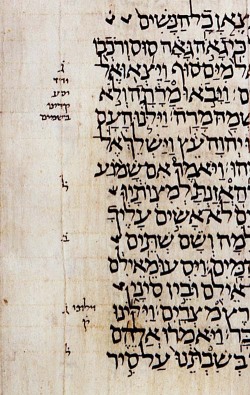 Leningrad Codex of the Hebrew Scriptures
Among the four Gospels, which are the only indisputable ones in the Church of God under heaven, I have learned by tradition that the first was written by Matthew, who was once a publican, but afterwards an apostle of Jesus Christ, and it was prepared for the converts from Judaism, and published in the Hebrew language. The second is by Mark, who composed it according to the instructions of Peter, who in his general epistle acknowledges him as a son, saying, "The church that is at Babylon elected together with you, saluteth you, and so doth Marcus, my son." And the third by Luke, the Gospel commended by Paul, and composed for Gentile converts. Last of all that by John. (Commentary on Matthew, fragment preserved in Eusebius, Ecclesiastical History VI:25:4-6)
Paul, who "fully preached the Gospel from Jerusalem and round about even unto Illyricum," did not write to all the churches which he had instructed and to those to which he wrote he sent but few lines. And Peter, on whom the Church of Christ is built, "against which the gates of hell shall not prevail," has left one acknowledged epistle; perhaps also a second, but this is doubtful.
Why need we speak of him who reclined upon the bosom of Jesus, John, who has left us one Gospel, though he confessed that he might write so many that the world could not contain them? And he wrote also the Apocalypse, but was commanded to keep silence and not to write the words of the seven thunders. He has left also an epistle of very few lines; perhaps also a second and third; but not all consider them genuine, and together they do not contain hundred lines. (Commentary on the Gospel of John, fragment preserved in Eusebius, Ecclesiastical History VI:25:7-10)
In the following quote, it is interesting to note that Origen did not consider Paul's Greek particularly "pure"; he calls it "rude."
Anyone who has the power to discern differences of phraseology will acknowledge that the verbal style of the epistle entitled "To the Hebrews" is not rude like the language of the apostle, who acknowledged himself "rude in speech" … but that its diction is purer Greek. anyone who carefully examines the apostolic text will also admit that the thoughts of the epistle are admirable and not inferior to the acknowledged apostolic writings.
… If I gave my opinion, I should say that the thoughts are those of the apostle, but the diction and phraseology are those of someone who remembered the apostolic teachings, and wrote down at his leisure what had been said by his teacher. Therefore if any church holds that this epistle is by Paul, let it be commended for this. For not without reason have the ancients handed it down as Paul's.
But who wrote the epistle, in truth, God knows. The statement of some who have gone before us is that Clement, bishop of the Romans, wrote the epistle, and of others that Luke, the author of the Gospel and the Acts, wrote it. (Homilies on Hebrews, fragment preserved in Eusebius, Ecclesiastical History VI:25:11-14)
There are many other points on which the careful student of the Gospels will find that their narratives do not agree; and these we shall place before the reader, according to our power, as they occur. The student, staggered at the consideration of these things, will either renounce the attempt to find all the Gospels true, and not venturing to conclude that all our information about our Lord is untrustworthy, will choose at random one of them to be his guide; or he will accept the four, and will consider that their truth is not to be sought for in the outward and material letter. (Commentary on John 10:2, from NewAdvent.org)
If we turn to the Lord, where also is the word of God, and where the Holy Spirit reveals spiritual knowledge, then the veil is taken away, and with unveiled face we shall behold the glory of the Lord in the holy Scriptures. (De Principiis. I:1:2.)
Dionysius, c. A.D. 250
I just have to point out that the following quote speaks of John's Greek writing as "without actual error" and "with the greatest elegance." This seems an interesting contrast with Origen's statement that Paul's Greek was "rude." Note, too, that Dionysius, bishop of Alexandria, and Origen, raised in Alexandria, would have at least met each other, though Dionysius was somewhat younger.
Some before our time have set aside this book [the Revelation of John, last book of our current New Testament], and repudiated it entirely, criticising it chapter by chapter, and endeavouring to show it to be without either sense or reason. ...
But I, for my part, could not venture to set this book aside, for there are many brethren who value it highly. Yet, having formed an idea of it as a composition exceeding my capacity of understanding, I regard it as containing a kind of hidden and wonderful intelligence on the several subjects which come under it. For though I cannot comprehend it, I still suspect that there is some deeper sense underlying the words. And I do not measure and judge its expressions by the standard of my own reason, but, making more allowance for faith, I have simply regarded them as too lofty for my comprehension; and I do not forthwith reject what I do not understand, but I am only the more filled with wonder at it, in that I have not been able to discern its import.
That this person was called John, therefore, and that this was the writing of a John, I do not deny. And I admit further, that it was also the work of some holy and inspired man. But I could not so easily admit that this was the apostle, the son of Zebedee, the brother of James, and the same person with him who wrote the Gospel which bears the title according to John, and the catholic epistle. But from the character of both, and the forms of expression, and the whole disposition and execution of the book, I draw the conclusion that the authorship is not his. ...
Thus the attentive reader will find the phrases, "the life," "the light," occurring often in both; and also such expressions as fleeing from darkness, holding the truth, grace, joy, the flesh and the blood of the Lord, the judgment, the remission of sins, the love of God toward us, the commandment of love on our side toward each other; as also, that we ought to keep all the commandments, the conviction of the world, of the devil, of Antichrist, the promise of the Holy Spirit, the adoption of God, the faith required of us in all things, the Father and the Son, named as such everywhere. And altogether, through their whole course, it will be evident that the Gospel and the Epistle are distinguished by one and the same character of writing.
But the Revelation is totally different, and altogether distinct from this; and I might almost say that it does not even come near it, or border upon it. Neither does it contain a syllable in common with these other books. ...
And furthermore, on the ground of difference in diction, it is possible to prove a distinction between the Gospel and the Epistle on the one hand, and the Revelation on the other. For the former are written not only without actual error as regards the Greek language, but also with the greatest elegance, both in their expressions and in their reasonings, and in the whole structure of their style. They are very far indeed from betraying any barbarism or solecism, or any sort of vulgarism, in their diction. For, as might be presumed, the writer possessed the gift of both kinds of discourse, the Lord having bestowed both these capacities upon him, viz., that of knowledge and that of expression.
That the author of the latter, however, saw a revelation, and received knowledge and prophecy, I do not deny. Only I perceive that his dialect and language are not of the exact Greek type, and that he employs barbarous idioms, and in some places also solecisms [grammatical mistakes]. ... And I would not have any one suppose that I have said these things in the spirit of ridicule; for I have done so only with the purpose of setting right this matter of the dissimilarity subsisting between these writings. (Fragments of Dionysius' writings preserved in Ecclesiastical History by Eusebius; cited from Ante-Nicene Fathers, vol. VI)
Cyprian, c. A.D. 250
Cyprian and Stephen
The disagreement between Cyprian and Stephen was over the baptism of heretics. Stephen said that if a person came to the Church having been baptized by a heretical group, then no further baptism was necessary. The Church could simply lay hands on the repentant person and receive them. Cyprian disagreed … quite vehemently.
It should be noted that the heretical group most at question was the schism of Novatian. Novatian was an elder who left the church in Rome to start his own congregation because he didn't believe that those who denied Christ during a persecution should be readmitted to the Church after the persecution. This was the only difference the Novatianists had with the apostolic churches. Otherwise, they maintained all the same doctrines.
It's possible that Stephen was including the gnostics in his decision, but it seems unlikely. The various gnostic sects bore no resemblance to the apostolic faith. It's much more likely that Stephen only wanted to admit Novatianist believers into the Church without rebaptizing them, though Cyprian accuses him of being willing to admit the followers of Marcion, a gnostic, without baptism.
Let nothing be innovated, says [Stephen, bishop of Rome], nothing maintained, except what has been handed down. From where is [his] tradition? Does it descend from the authority of the Lord and the Gospel or does it come from the commands and letters of the apostles? For that those things which are written must be done, God witnesses and admonishes, saying to Joshua … "The book of this Law shall not depart from your mouth, but you shall meditate on it day and night so that you may be careful to do all that is written in it" [Josh. 1:8]. Also, the Lord, when he sent his apostles, commands that the nations should be baptized and taught to observe all that he commanded. If, therefore, it is either prescribed in the Gospel or contained in the letters or Acts of the apostles, that those who came from any heresy should not be baptized, but only hands laid on them to repentance, let this divine and holy tradition be observed. But if everywhere heretics are called nothing other than adversaries and antichrists, if they are pronounced as people to be avoided, twisted and condemned by themselves, why is it that they should not be found worthy to be condemned by us, since it is obvious by the apostolic testimony that they are condemned by themselves? So no one ought to defame the apostles as though they had approved of the baptism of heretics, or had taken communion with them without the Church's baptism, when they, the apostles, wrote such things about the heretics.
… If in time past it was never at all prescribed nor written that only hands should be laid upon a heretic for repentance, and that with only this we may take communion with him; and if there is only one baptism, which … is granted of the divine condescension to the Church alone, then what obstinacy is it, or what presumption, to prefer human tradition to divine ordinance, and not to observe that God is indignant and angry as often as human tradition relaxes and passes by the divine precepts? As he cries out and says by Isaiah the prophet, "This people honoureth me with their lips, but their heart is far from me. In vain do they worship me, teaching the doctrines and commandments of men." (Letter to Pompeius, Letter 73:2-3)
Eusebius of Caesarea, A.D. 323
Eusebius and the "Lost Books" of the Bible
It is typical, especially for modern day gnostics like Elaine Pagel and Bart Ehrman, to accuse Constantine, the Council of Nicea, or Eusebius of removing books from the Bible. This is a myth.
As you can see, Eusebius did not devise his own canon. Like Augustine (see below) and all other early Christians, he got it from the churches. He even distinguishes between those books accepted by all, those under dispute, and those rejected by all.
As you can also see, his canon is not a perfect match for ours, as there were decisions still not made at that time that have been made since.
Since we are dealing with this subject it is proper to sum up the writings of the New Testament which have been already mentioned. First then must be put the holy quaternion [set of 4] of the Gospels; following them the Acts of the Apostles. After this must be reckoned the epistles of Paul; next in order the extant former epistle of John, and likewise the epistle of Peter, must be maintained. After them is to be placed, if it really seem proper, the Apocalypse of John [i.e., the Book of the Revelation which is in our modern Bible], concerning which we shall give the different opinions at the proper time. These then belong among the accepted writings.
Among the disputed writings, which are nevertheless recognized by many, are extant the so-called epistle of James and that of Jude, also the second epistle of Peter, and those that are called the second and third of John, whether they belong to the evangelist or to another person of the same name.
Among the rejected writings must be reckoned also the Acts of Paul, and the so-called Shepherd, and the Apocalypse of Peter, and in addition to these the extant epistle of Barnabas and the so-called Teachings of the Apostles; and besides, as I said, the Apocalypse of John, if it seem proper, which some, as I said, reject, but which others class with the accepted books.(Church History III:25:1-4)
Augustine of Hippo, c. A.D. 390
Augustine's Canon
Now the whole canon of Scripture … is contained in the following books: five books of Moses—that is, Genesis, Exodus, Leviticus, Numbers, Deuteronomy—one book of Joshua the son of Nun; one of Judges; one short book called Ruth; … four books of Kings and two of Chronicles. …
The books just mentioned are history, which … follows the order of the events. There are other books which seem to follow no regular order … such as Job, Tobias, Esther, Judith, the two books of Maccabees, and the two of Ezra …
Next are the prophets, in which there is one book of the Psalms of David and three books of Solomon—Proverbs, Song of Songs, and Ecclesiastes. For two books, one called Wisdom and the other Ecclesiasticus, are ascribed to Solomon … but the most likely opinion is that they were written by Jesus the son of Sirach. Still, they are to be reckoned among the prophetical books since they have attained recognition as being authoritative.
The remainder are the books which are strictly called the prophets. ... Since they have never been disjoined, they are reckoned as one book … : Hosea, Joel, Amos, Obadiah, Jonah, Micah, Nahum, Habakkuk, Zephaniah, Haggai, Zechariah, Malachi. Then there are the four greater prophets: Isaiah, Jeremiah, Daniel, Ezekiel.
The authority of the Old Testament is contained within the limits of these forty-four books. [Ed. note: in his Retractiones, he apologizes for referring to them as the "Old Testament."]
That of the New Testament is contained within the following: four books of the Gospel—according to Matthew, according to Mark, according to Luke, according to John—fourteen epistles of the Apostle Paul—one to the Romans, two to the Corinthians, one to the Galatians, to the Ephesians, to the Philippians, two to the Thessalonians, one to the Colossians, two to Timothy, one to Titus, to Philemon, to the Hebrews—two of Peter, three of John, one of Jude, and one of James, one book of the Acts of the Apostles, and one of the Revelation of John. (On Christian Doctrine II.8.13)
Now, in regard to the canonical Scriptures, [the skillful interpreter] must follow the judgment of the greater number of catholic churches. Among these, of course, a high place must be given to such as have been thought worthy to be the seat of an apostle and to receive epistles.
Accordingly, among the canonical Scriptures he will judge according to the following standard: to prefer those that are received by all the catholic churches to those which some do not receive. Among those which are not received by all, he will prefer such as have the sanction of the greater number and those of greater authority to such as are held by the smaller number and those of less authority.
If, however, he shall find that some books are held by the greater number of churches, and others by the churches of greater authority (though this is not a very likely thing to happen), I think that in such a case the authority on the two sides is to be looked upon as equal. (On Christian Doctrine II.8.12)
Jerome, A.D. 390 - 400
Matthew says, ... " ... for thus it is written by the prophet, 'And you Bethlehem in the land of Judah are not the least among the princes of Judah, for out of you shall come a governor that shall rule my people Israel'" [Matt. 2:5-6]. ... You will be more surprised still at the difference in words and order between Matthew and the Septuagint if you look at the Hebrew which runs thus: "eBut you Bethlehem Ephratah, though you be little among the thousands of Judah, yet out of you shall he come forth to me he that is to be ruler in Israel" [Mic. 5:2]
... The evangelist writes, " ... are not the least among the princes of Judah." In the Septuagint this is, " ... are small to be among the thousands of Judah," while the Hebrew gives, " ... though you be little among the thousands of Judah."
There is a contradiction here—and that not merely verbal—between the evangelist and the prophet, for in this place at any rate both Septuagint and Hebrew agree. The evangelist says that he is not little among the princes of Judah, while the passage from which he quotes says exactly the opposite of this; "You are small indeed and little, but yet out of you, small and little as you are, there shall come forth for me a leader in Israel." This sentiment in harmony with that of the apostle, "God has chosen the weak things of the world to confound the things which are mighty" [1 Cor. 1:27]
Let us pass on now to the apostle Paul who writes thus to the Corinthians: "For had they known it, they would not have crucified the Lord of glory. But, as it is written, 'Eye has not seen, nor ear heard, nor has it entered the heart of man, the things which God has prepared for them that love Him'" [1 Cor. 2:8-9]. ... It is found in Isaiah according to the Hebrew text: "Since the beginning of the world men have not heard nor perceived by the ear, nor has the eye seen, oh God, beside you what you have prepared for them that wait for thee" [Is. 64:4]. The Septuagint has rendered the words quite differently: "Since the beginning of the world we have not heard, nor have our eyes seen any God beside you and your true works, and you will show mercy to them that wait for you."
We see then from what place the quotation is taken, and yet the apostle has not rendered the original word for word, but, using a paraphrase, he has given the sense in different terms.
In his epistle to the Romans the same apostle quotes these words from Isaiah: "Behold, I lay in Zion a stone of stumbling and a rock of offense" [Rom. 9:33], a rendering which is at variance with the Greek version, yet agrees with the original Hebrew. The Septuagint gives an opposite meaning, "that you do not fall on a stone of stumbling nor on a rock of offense" [Is. 8:14]. The apostle Peter agrees with Paul and the Hebrew, writing: " ... but to them that do not believe, a stone of stumbling and a rock of offense" [1 Pet. 2:8].
From all these passages it is clear that the apostles and evangelists—in translating the Old Testament Scriptures—have sought to give the meaning rather than the words, and that they have not greatly cared to preserve forms or constructions, so long as they could make clear the subject to the understanding. (To Pammachius on the Best Method of Translating, par. 9, as found in: The Nicene and Post-Nicene Fathers, series II, vol. VI)
Let [a Christian virgin's] treasures be not silks or gems but manuscripts of the holy Scriptures. In these let her think less of gilding, Babylonian parchment, and arabesque patterns than of correctness and accurate punctuation.
Let her begin by learning the psalter [i.e., Psalms], and then let her gather rules of life out of the proverbs of Solomon. From the Preacher [i.e., Ecclesiastes] let her gain the habit of despising the world and its vanities. Let her follow the example set in Job of virtue and of patience. Then let her pass on to the Gospels, never to be laid aside when once they have been taken in hand. Let her also drink in with a willing heart the Acts of the Apostles and the Epistles. As soon as she has enriched the storehouse of her mind with these treasures, let her commit to memory the prophets, the heptateuch [i.e., the five books of Moses, Joshua, and Judges], the books of Kings and of Chronicles, the rolls also of Ezra and Esther.
When she has done all these she may safely read the Song of Songs but not before: for, were she to read it at the beginning, she would fail to perceive that, though it is written in fleshly words, it is a marriage song of a spiritual bride. Not understanding this she would suffer hurt from it.
Let her avoid all apocryphal writings, and if she is led to read such not by the truth of the doctrines which they contain but out of respect for the miracles contained in them; then let her understand that they are not really written by those to whom they are ascribed, that many faulty elements have been introduced into them, and that it requires infinite discretion to look for gold in the midst of dirt.
Cyprian's writings let her have always in her hands. The letters of Athanasius and the treatises of Hilary she may go through without fear of stumbling. Let her take pleasure in the works and wits of all in whose books a due regard for the faith is not neglected. But if she reads the works of others let it be rather to judge them than to follow them. (To Laeta, par. 12, as found in NICENE AND POST-NICENE FATHERS, SERIES 2: The Nicene and Post-Nicene Fathers, series II, vol. VI)
Socrates Scholasticus, c. A.D. 450
The following quote addresses the use of the various debate techniques taught by the Greek philosophers. Socrates is defending the use of them.
Greek literature certainly was never recognized either by Christ or his apostles as divinely inspired, nor on the other hand was it wholly rejected as pernicious. And this they did, I conceive, not inconsiderately. For there were many philosophers among the Greeks who were not far from the knowledge of God ... By not forbidding the study of the learned works of the Greeks, they left it to the discretion of those who wished to do so.
This is our first argument in defense of the position we took. Another may be put this way: The divinely inspired Scriptures undoubtedly inculcate doctrines that are both admirable in themselves and heavenly in their character: they also eminently tend to produce piety and integrity of life in those who are guided by their precepts, pointing out a walk of faith which is highly approved by God. But they do not instruct us in the art of reasoning, by means of which we may be enabled successfully to resist those who oppose the truth. Besides adversaries are most easily foiled, when we can use their own weapons against them. (Ecclesiastical History of Socrates Scholasticus III:16)
Martin Luther, 1517 - 1546
Martin Luther quotes the Wisdom of Solomon ...
On the other hand, he who is not at one with God, or doubts, hunts and worries in what way he may do enough and with many works move God. He runs to St. James of Compostella, to Rome, to Jerusalem, hither and yon, prays St. Bridget's prayer and the rest, fasts on this day and on that, makes confession here, and makes confession there, questions this man and that, and yet finds no peace. He does all this with great effort, despair and disrelish of heart, so that the Scriptures rightly call such works in Hebrew Avenama, that is, labor and travail. And even then they are not good works, and are all lost. Many have been crazed thereby; their fear has brought them into all manner of misery. Of these it is written, Wisdom of Solomon v: "We have wearied ourselves in the wrong way; and have gone through deserts, where there lay no way; but as for the way of the Lord, we have not known it, and the sun of righteousness rose not upon us." (A Treatise on Good Works)
Samuel Clarke, d. 1729
As in matters of speculation and philosophical inquiry, the only judge of what iright or wrong, is reason and experience ; so in matters either of humane testimony or divine Revelation, the only certain rule of truth is the testimony or the Revelation.(The Scripture-Doctrine of the Trinity. [London] 1719. p.v)
The Christian Revelation is the Doctrine of Christ and his Apostles ... For the right apprehending of which Doctrine, men are .... sincerely to make use of their best understanding ; and, in order thereunto, to take in all the helps they can find, either from living instructors or ancient writers ; but this, only as a means to assist and clear up their own understanding, not to over-rule it. ... The only rule of Fath therefore to every Christian is the Doctrine of Christ ; and that Doctrine, as applied to him by his own understanding. In which matter, to preserve his understanding from erring, he is obliged indeed, at his utmost peril, to lay aside all vice and all prejudice, and to make use of the best assistances he can procure.(The Scripture-Doctrine of the Trinity. [London] 1719. p.v-vi)
... therefore the Books of Scripture are to us now not only the rule, but the whole and only rule of truth in matters of Religion.(The Scripture-Doctrine of the Trinity. [London] 1719. p.vi)
Nevertheless, through the whole Scripture is the rule of truth ; and whatever is ther delivered is infallibly true ; yet because there is contained in those writings great variety of things, and many occasional doctrines and decisions of controversies, which though all equally true, yet are not all equally necessary to be known and understood by all Christians of all capacitites ; therefore the Church from the beginning has out of the Scripture selected those plain fundamental doctrines, which were there delivered as the terms or conditions of Salvation, of necessity to be known and understood by all Christians whatsoever. And these, all persons were taught in their Baptismal Creeds. (The Scripture-Doctrine of the Trinity. [London] 1719. p.vi-vii)
For, matters of speculation indeed, of philosophy, or art ; things of human invention, experience or disquisition ; improve generally from small beginnings, to greater and greater certainty, and arrive at perfection by degrees ; but matters of Revelation and divine testimony, are on the contrary complete at first ; and Christian Religion, was most perfect at the beginning ... In the days of the Apostles therefore, christianity (sic) was perfect. (The Scripture-Doctrine of the Trinity. [London] 1719. p.vi-vii)
Philip Schaff, c. 1890
[The Reformers] added, moreover, to the external evidence, the more important internal evidence on the intrinsic excellency of the Scripture, as the true ground on which its authority and claim to obedience rests; and they established a firm criterion of canonicity, namely, the purity and force of teaching Christ and his gospel of salvation. They did not reject the testimonies of the fathers, but they placed over them what Paul calls the "demonstration of the Spirit and of power" (1 Cor. 2:4). (History of the Christian Church, vol. VII, ch. I, sec. 9)
E.R. Kalin, 1971
My investigation of the writings of Irenaeus, Origen, Eusebius, and several other fathers up to the year AD 400 has failed to turn up a single instance in which any of these writers referred to an orthodox writing outside the New Testament as noninspired. If the Scriptures were the only writings the fathers considered to be inspired, one would expect them to say so, at least once in a while. ("The Inspired Community: A Glance at Canon History," Concordia Theological Monthly 42 (1971):543; as cited in A High View of Scripture?, from the Evangelical Ressourcement series. Baker Academic, 2007, p. 60, emphasis in original)
A.C. Sundberg, Jr., 1972
It is also clear that the Jewish literature received by Christianity was not a closed collection; it was not a canon. Since it was cited as authoritative, it is proper to call it "Scripture." But since it was not a closed collection, it is not proper to call it "canon." ("Towards a Revised History of the New Testament Canon," Studia evangelica 4, no. 1 (1968): p. 453; as cited in A High View of Scripture?, from the Evangelical Ressourcement series. Baker Academic, 2007, p. 45)
J. Barton, 1997
The picture that emerges is surprisingly clear. From the Apostolic Fathers onwards, the Synoptic Gospels (especially Matthew), the Fourth Gospel, and the major Pauline Epistles are cited very much more often than one would predict, if one supposed that the whole of the New Testament we now have was equally "canonical" or important. Correspondingly, the rest of the New Testament (including Acts) is manifestly less important. The third category, books scarcely cited at all, contains most of those which later decisions and decrees affirm to be non-canonical; even in the earliest period none of them is cited even so often as the books of the second class. (Holy Scripture: Canon, Authority, and Criticism. Philadelphia:Westminster John Knok, 1997, p. 17, as cited in A High View of Scripture?, from the Evangelical Ressourcement series. Baker Academic, 2007, p. 50)
Craig D. Allert, 2007
Some of the following quotes address Evangelical views because that is my background and the Christians with whom I have the most interaction (both positively and negatively  ).
).
Most evangelicals, particularly at the popular level, have what I call a "dropped out of the sky" understanding of the Bible. (A High View of Scripture?, from the Evangelical Ressourcement series, p. 10)
We evangelicals have come close to deifying this collection of texts with little to no understanding of how they came to be collected into the Bible. (ibid., p. 12)
The content of the biblical canon, as we know it today, is not a particularly early feature of ancient Christianity: the Bible was not always "there" in early Christianity. Yet, the church still continued to function in its absence. This fact warrants an examination of how this was so. (ibid., p. 12)
It is one thing to say that the early church possessed all the documents that went, eventually, to make up what we call the New Testament. It is quite another thing to say that the early church leaders consciously collected a select few (twenty-seven) documents for the direct purpose of including them, and only them, in the New Testament. (A High View of Scripture?, from the Evangelical Ressourcement series, pp. 39-40)
The conclusion Sundberg [A.C. Sundberg, Jr., author of "Towards a Revised History of the New Testament Canon" in the Studia evangelica 4, no. 1] comes to is that the Christian church did not receive an Old Testament canon of Scripture. It is better to say that the church received Scripture on the way to a definite canon in Judaism.
… the church received from Judaism … the religious literature that circulated freely in Judaism before 70 CE—a closed collection of Law, a closed collection of Prophets, and a third, open body of undefined literature that included the later defined Writings, the books Protestants have come to call the Apocrypha and Pseudipigrapha, and other books known only by name or no longer extant. Only in the third century did the church come to the issue of defining the Old Testament for itself.(ibid., pp. 44-45, emphasis mine)
In this understanding we can conceive of an authoritative body of Christian Scripture in the first century, but even into the fifth century, we cannot claim that this body of literature was closed. This has direct implications for the argument that the early church appealed to the Bible and the Bible alone for its doctrine: one cannot properly speak of a Bible in the first several centuries of the church's existence. This is why it is so important to be precise in distinguishing between "Scripture" and "canon." (ibid., p. 51)
The variety of canonical lists in the fourth and fifth centuries testifies to the fact that even then the church had not settled the matter for all. (ibid., p. 57)
All documents considered orthodox by the early church were, by implication, believed to be inspired. (ibid., p. 59)
The question at issue here is not, Is the Bible inspired? but rather, Is inspiration seen by the fathers to be the unique possession of the canonical books alone? Perhaps we can better state the question thus: Did the early church view only the documents that went into the New Testament canon as inspired and those alone? The short answer to this question is No. The early church considered not only other documents as inspired, but also many aspects of the church's life including bishops, monks, interpreters of Scripture, martyrs, councils, and a wide array of prophetic gifts. (ibid., p. 59)
All documents considered orthodox by the early church were, by implication, believed to be inspired. (A High View of Scripture?, from the Evangelical Ressourcement series, p. 59)
"Rod of Alexandria" blog post, 2010
Inerrancy is only a cover for people who want to say their hermeneutic is inerrant. (This was a comment on a blog that can no longer be found online.)
"Ken," 2010
Clement puts the word of God, the Scriptures as the ultimately authority and does not say, "obey me, as a bishop of bishops or pope"; no, he says "look to the Scriptures and repent of sins of arrogance and jealousy, because the Scriptures say." ("An Evangelical Introduction to Church History (Part 2)" on Beggars All: Reformation and Apologetics blog; I didn't correct any typos except adding the missing quotation mark at the end)
Jacob Prahlow, 2017
The first pandect (Bible in one book) was produced in the 8th century. ("The Bible in Thirty Chapters." Web Article. Pursuing Veritas. Retrieved 26 September 2017 from https://pursuingveritas.com/2017/09/26/the-bible-in-thirty-chapters/)

Recent Articles


-
Dispensations of the Bible: Quotes from the Early Church Fathers
Mar 04, 26 09:03 AM
There are many disputes about the dispensations of the Bible. What did the early church fathers say they were? -
The Role of Early Church Unity in Strengthening Modern-Day Faith
Dec 24, 25 01:51 PM
The Role of Early Church Unity in Strengthening Modern-Day Faith covers unity in early Christian history and modern application -
FAQ: How to Start Reading the Early Church Fathers
Jun 02, 25 04:01 PM
 People often ask me how to start reading the early church fathers. Here's the answer.
Early Church History Newsletter
You will be notified of new articles, and I send teachings based on the pre-Nicene fathers intermittently.
When you sign up for my newsletter, your email address will not be shared. We will only use it to send you the newsletter.