Christian-History.org does not receive any personally identifiable information from the search bar below.
The Council of Nicea
The story of the Council of Nicea starts with a priest named Arius and a bishop named Alexander in a city called Alexandria.
The study I put into these articles has resulted in a book called Decoding Nicea. Often reviewed as "interesting," it tells the story of Nicea in more detail than is possible here. Available wherever books are sold. See Amazon reviews.
This page is Part 1 of 4 parts.
The Background
Note: Yesterday (Mar. 10, 2009) I read an article by three church historians saying, "It didn't start with Arius and Alexander." Here's why they're wrong.
The year was 318, and Christianity was enjoying a huge revival (that is, if you're okay with me calling a huge influx of unconverted pagans into the church a revival). The Great Persecution—only the 2nd empire-wide persecution and easily the longest—had ended with Galerius' Edict of Toleration in 311 followed by Constantine's Edict of Milan in 313.
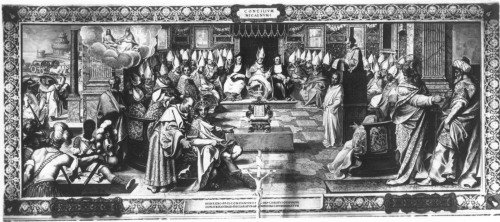 Fresco of the Council of Nicea
Throughout the 3rd century, Christianity was rapidly becoming more formal. The churches were more organized, leadership had grown larger and more structured as the Church increased in size, and more and more rules were used to keep Christian conduct in line.
In the past, during the apostolic era and the 2nd century, relationships and knowing one another had provided restraint in Christian's lives. Rules are never as effective as love and peer pressure, so the discipline of the Church and Christians in it had eroded.
Alexander the Metropolitan
Alexander was more than just a bishop. He was a "Metropolitan." Metropolitans were in leadership over multiple congregations in large cities and surrounding villages. In the early fourth century, the bishops of Rome and Alexandria were the two most powerful metropolitans. The First Council of Nicea, only 7 years in the future, would confirm their authority over country-size areas around their city.
A council that Alexander and Arius made necessary.
(I can't give you a better reference for that last paragraph than the "feel" of the 2nd century and 3rd century writings. The 3rd century is clearly much more liturgical, and the accounts of Christians lapsing during persecution are muliplied many times over.)
Lines Are Drawn
One day, Alexander called together the elders of Alexandria to ask them questions about the Scripture. Arius was sharp-tongued, bold, and no stranger to controversy; he had already been excommunicated once by a previous bishop in 311. He told Alexander that if the Son was begotten by the Father, then the Son had a beginning. Before he was begotten by the Father, he did not exist.
Alexander told him this was heresy, but Arius refused to back down.
Alexander had to do something, but it took time. Apparently he was patient (some say slow) in dealing with Arius. Eventually, though, after consulting with other bishops, he removed Arius from office and even excommunicated him [i.e.; banned him from the communion table]. This happened in A.D. 321, four years before the Council of Nicea.
Arianism
Since this is the 21st century, it is very unlikely that you know the context of Arius' argument.
In the Pre-Nicene Church [i.e., before the Council of Nicea] everyone believed that the Son was begotten in eternity past, and that this was the meaning of Proverbs 8:22. However, Arius claimed the Son did not exist prior to being begotten, while the early churches believed he had already existed inside the Father as the Father's Logos [Word,Wisdom, or Reason]. (Tertullian, Against Praxeas 5; Origen, De Principiis I:2:2; etc.)
Thus, Arius was speaking against the accepted tradition of the Church, a big no-no in those days.
Arius was now outside the church, but he was not about to drop the argument.
Fanning the Flames Leading to the Council of Nicea
Having lost his battle with the bishops, Arius took his case to "sailors, millers, and travelers." A master of poetry, he composed jingles to be sung in the marketplaces in defense of his doctrine.
Worse, he also convinced Eusebius, the bishop of Nicomedia and a popular church leader, to join his cause.
This was bad because Arius was wrong. It was the job of early church leaders to preserve the teaching of the apostles, not to add to it or change it (Irenaeus, Against Heresies III:2:2, c. A.D. 185). The universal testimony of Arius' predecessors over the previous two centuries was that the apostles had taught their churches that the Son had existed prior to being begotten; he had existed inside the Father as his Logos.
It's hard for me to imagine how Arius or Eusebius (of Nicomedia) could not have known this. While I understand that the writings of earlier church leaders could not be picked up at their local Christian bookstore, earlier church writings were extensively quoted by 4th-century authors. We know they were available.
Eusebius the Arian
and
Eusebius the Historian
Don't confuse Eusebius of Nicomedia with the historian Eusebius Pamphilius of Caesarea.
The former adopted Arianism and was rightly censured by the Council of Nicea. The latter was in high regard among contemporaries, but he is occasionally accused of Arianism by later churchmen and historians who do not understand the Nicene and Ante-Nicene view of the Trinity.
Even if Arius and Eusebius were unaware of earlier tradition at the beginning, the teaching of the apostles, handed down to the churches, had to have been explained to them repeatedly before the Council of Nicea ever happened.
Eusebius of Caesarea wrote his Ecclesiastical History—rife with quotes—just 2 years after Arius' exile from Alexandria (and 2 years before the Council of Nicea). Surely the opponents of Arius and Eusebius (of Nicomedia) told them what men like Justin Martyr, Athenagoras, Tertullian, Origen, and others had taught. Arius and Eusebius simply ignored it; Arius forever and Eusebius until the truth was forced upon him at the Council of Nicea.
The Flames Get Out of Control
Between Arius' natural salesmanship and Eusebius' popularity, the Arian message began to spread.
It spread so much that it caught the notice of the emperor, Constantine the Great.
Constantine was in the process of uniting the Roman empire under his own rule. There had been as many as four emperors at once during the reigns of Constantine and his father Constantius.
Now reduced to two emperors, civil war had ignited in A.D. 320 when co-emperor Licinius ignored the Edict of Milan and reinstituted the persecution of Christians. Constantine took that as an opportunity to rid himself of his rival; however, it would take 4 years to make that happen, and the battles would not end until September, 324.
The Catholic Church
Catholic actually means "universal." It was a common adjective applied to the Church/churches in the 4th century. It is a mistake to assume the word "catholic" was a reference to the Roman Catholic hierarchy, which did not exist at the time of the Council of Nicea.
The Council of Nicea made a number of decisions that give us a clear picture of the authority of Rome at the time. Those decisions are called "canons." Canon VI reads:
Let the ancient customs in Egypt, Libya and Pentapolis prevail, that the Bishop of Alexandria have jurisdiction in all these, since the like is customary for the Bishop of Rome also. Likewise in Antioch and the other provinces, let the Churches retain their privileges.
The extent of the jurisdiction of the bishops of Rome, Alexandria, and Antioch are not exactly given, except for the bishop of Alexandria, but they were clearly not universal.
There is extensive evidence that there was no "pope" in the Ante-Nicene Church. Thus, any references at or before the Council of Nicea to the "catholic" Church or "catholic" churches are simply references to the Church universal.
It was during this civil war that Arius and Eusebius, in complete disregard of the commands of Christ and writings of the apostles, sought to divide the Church.
Constantine recognized the danger of this. With so many of his subjects converted (so-called) to Christianity, splitting the Church could easily split the empire!
In A.D. 323, Constantine summoned bishop Hosius of Cordova (in modern Spain) to help resolve the dispute. Hosius delivered a letter—purportedly from Constantine but likely written by Hosius—to both Alexander and Arius informing them that neither was behaving properly.
Alexander was told that the questions he asked of Arius were inappropriate. Arius was told that opinions such as his should be kept to himself.
Neither was moved by the letter.
The Council of Nicea Is Summoned by Constantine
Once Constantine dispatched of Licinius, he was ready to turn more focused attention on his problem in the Church.
Constantine the Great was no fool. He was a master statesman and diplomat. He did not simply demand that the bishops of the churches in the empire appear before him in Constantinople. He called a council in a city easily accessible to all the bishops of the empire, Nicea in modern-day Turkey. He also paid their travel expenses and welcomed them with great pomp and circumstance.
Wooed and comfortable, the bishops gathered at the Council of Nicea to discuss the dissension that had by now spread across most of north Africa and the Middle East. Constantine asked if he could participate, and the bishops granted their host this privilege. While not a churchman, he was a diplomat, and he would play a major role in the proceedings.
It was the summer of 325.
Go to Part II: The Proceedings of the Council of Nicea

Recent Articles


-
I Desire Mercy Not Sacrifice
Apr 22, 24 08:28 PM
Why did Hosea prophesy, 'I desire mercy and not sacrifice,' and why did Jesus quote it twice in the Gospel of Matthew? The answer may shock you. -
Reconciling the Evangelical Paul with the Biblical Paul
Mar 25, 24 12:53 PM
Paul does not need to be reconciled with James because he says all the things James does. We need to reconcile the evangelical Paul with the biblical Paul. -
How to Live Holy
Feb 28, 24 12:06 PM
The Bible clearly teaches us how to live holy by his grace, by the Holy Spirit, the fellowship of the church. It also calls us to make every effort.
Early Church History Newsletter
You will be notified of new articles, and I send teachings based on the pre-Nicene fathers intermittently.
When you sign up for my newsletter, your email address will not be shared. We will only use it to send you the newsletter.