Christian-History.org does not receive any personally identifiable information from the search bar below.
Quotes About Roman Catholicism
Powerful or fascinating Christian quotes about Roman Catholicism from throughout history, addressing the papacy, apostolic succession, tradition and any other uniquely Catholic doctrine.
See also apostolic succession quotes.
My book, Rome's Audacious Claim, goes through the church fathers to refute the claim of Roman Catholic apologists that there was a pope in the first century. It explains how fourth-century events explain the rise of the papacy, the (later) development of Roman Catholicism, and then opens the door on the sordid results of Roman religious rule. Available where books are sold. See Amazon reviews.
Clement of Rome, A.D. 96
It behooves us to do all things in order which the Lord has commanded us to perform at stated times. He has enjoined offerings and service to be performed, and that not thoughtlessly or irregularly, but at the appointed times and hours. Where and by whom he desires these things to be done, he himself has fixed by his own supreme will, in order that all things being piously done according to his good pleasure, may be acceptable to him.
Those, therefore, who present their offerings at the appointed times, are accepted and blessed; for inasmuch as they follow the laws of the Lord, they do not sin. For his own peculiar services are assigned to the high priest; their own proper place is prescribed to the priests; their own special ministrations fall upon on the Levites; the layman is bound by the laws that pertain to laymen. Let every one of you, brothers, give thanks to God in his own order, living in all good conscience, with becoming gravity, and not going beyond the rule of the ministry prescribed to him. Not in every place, brothers, are the daily sacrifices offered, or the peace-offerings, or the sin-offerings and the trespass-offerings, but in Jerusalem only. And even there they are not offered in any place, but only at the altar before the temple, that which is offered being first carefully examined by the high priest and the ministers already mentioned. Those, therefore, who do anything beyond that which is agreeable to his will, are punished with death. You see, brothers, that the greater the knowledge that has been vouchsafed to us, the greater also is the danger to which we are exposed. (First Clement 40 & 41)
The quotes from First Clement 42 and 44, which is actually signed by the church in Rome and not Clement himself, are included to address the Protestant argument that Clement recognized two classes of church leadership, bishops/elders and deacons, the bishops and elders being the same, in Rome in A.D. 96. The rest are included for more obvious reasons and require no explanation.
[The apostles] appointed the firstfruits of their labors, after first proving them by the Spirit, to be bishops and deacons of those who would afterward believe. (First Clement 42)
Our apostles also knew, through our Lord Jesus Christ, that there would be strife on account of the title of bishop. For this reason, therefore, they appointed those already mentioned, then afterwards gave instructions that when these should fall asleep, other approved men should succeed them in their ministry. We are of the opinion, therefore, that those appointed by them—or afterwards by other eminent men—with the consent of the whole Church, and who have blamelessly served the flock of Christ in a humble, peaceable, and disinterested spirit, and have for a long time possessed the good opinion of all, cannot be justly dismissed from the ministry. For our sin will not be small, if we eject from the office of bishop those who have fulfilled its duties blamelessly and in holiness. Blessed are those elders who, having finished their course before now, have obtained a fruitful and perfect departure [from this world], for they have no fear that anyone might deprive them of the place now appointed them. But we see that you have removed some men of excellent behavior from the ministry, which they fulfilled blamelessly and with honor. (First Clement 44)
Tertullian, c. A.D. 210
I had to take out a lot of unnecessary additions from the translator of this text. Only one was important. In the original translation, Dr. Holmes writes, "... Rome, from which their comes even into our own hands the very authority [of the apostles]." It seemed to me that "of the apostles" was a redundant and pointless addition. The whole point of Tertullian's comment is that all these churches have the authority of the apostles. Tertullian was saying something special about Rome. I chose "true authority" as the best translation of "of the apostles" wasn't added. I'm pretty sure that Tertullian meant "our authority here in Carthage" because Rome was the nearest apostolic church to Carthage, from which Tertullian was writing.
Come now, you who would indulge a better curiosity, if you would apply it to the business of your salvation, run over the apostolic churches, in which the very thrones of the apostles are still preeminent in their places, in which their own authentic writings are read, uttering the voice and representing the face of each of them severally. Achaia is very near you, you find Corinth. Since you are not far from Macedonia, you have Philippi; you have the Thessalonians. Since you are able to cross to Asia, you get Ephesus. Since, moreover, you are close upon Italy, you have Rome, from which there comes even into our own hands the true authority. How happy is its church, on which apostles poured forth all their doctrine along with their blood! where Peter endures a passion like his Lord’s! where Paul wins his crown in a death like John’s where the Apostle John was first plunged, unhurt, into boiling oil, and thence remitted to his island-exile! See what she has learned, what taught, what fellowship has had with even churches in Africa! One Lord God does she acknowledge, the Creator of the universe, and Christ Jesus [born] of the Virgin Mary, the Son of God the Creator; and the resurrection of the flesh; the law and the prophets she unites in one volume with the writings of evangelists and apostles, from which she drinks in her faith. This she seals with the water [of baptism], arrays with the Holy Ghost, feeds with the Eucharist, cheers with martyrdom, and against such a discipline thus [maintained] she admits no gainsayer. This is the discipline which I no longer say foretold that heresies should come, but from which they proceeded. However, they were not of her, because they were opposed to her. (Prescription Against Heretics, ch. 36)
On the whole, then, if that is evidently more true which is earlier, if that is earlier which is from the very beginning, if that is from the beginning which has the apostles for its authors, then it will certainly be quite as evident, that that comes down from the apostles, which has been kept as a sacred deposit in the churches of the apostles. Let us see what milk the Corinthians drank from Paul; to what rule of faith the Galatians were brought for correction; what the Philippians, the Thessalonians, the Ephesians read by it; what utterance also the Romans give, so very near, to whom Peter and Paul conjointly bequeathed the gospel even sealed with their own blood. We have also St. John’s foster churches. For although Marcion rejects his Apocalypse, the order of the bishops, when traced up to their origin, will yet rest on John as their author. In the same manner is recognized the excellent source of the other churches. (Against Marcion, Bk. IV, ch. 5)
Cyprian, c. A.D. 250
None of us set himself up as a bishop of bishops, nor by tyrannical terror does any compel his colleague to the necessity of obedience. Every bishop, according to the allowance of his liberty and power, has his own proper right of judgment, and can no more be judged by another than he himself can judge another. (Seventh Council of Carthage Under Cyprian)
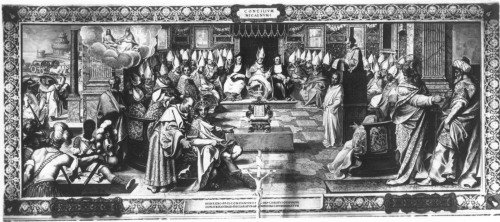 Fresco of the Council of Nicea
Eusebius, A.D. 323
There are two points to be made here in regard to Roman Catholic claims. Note that as late as 323, Eusebius seems to have no clue that Rome was claiming authority over the whole church based on a succession from Peter (Catholic Catechism, par. 881-2). The claim it now, but Eusebius had either never heard of that doctrine or he did not believe it because he does not attribute Rome's succession to Peter. The second point is that Eusebius does mention the succession of bishops in Rome, though he does that with many churches in his history.
The blessed apostles, having founded and established the church [of Rome], entrusted the office of the episcopate to Linus. Paul speaks of this Linus in his epistle to Timothy. Anacletus succeeded him, and after Anacletus ... (Church History. Book V. Chapter VI. Par. 1.)
Athanasius, A.D. 325 - 370
While [the Arians], like men sprung from a dunghill, truly "spoke from the earth" [Jn. 3:31], the bishops [of Nicea], not having invented their phrases for themselves, but having testimony from their fathers, wrote as they did. For ancient bishops, of the great Rome and our city [i.e., Alexandria, Egypt, where Athanasius was bishop], some 130 years ago, wrote and censured those who said that the Son was a creature and not consubstantial with the Father. (Synodal Letter to the Bishops of Africa 6)
Jerome, d. 420
Since the East, shattered as it is by the long-standing feuds, subsisting between its peoples, is bit by bit tearing into shreds the seamless vest of the Lord, “woven from the top throughout” [Jn. 19:23], since the foxes are destroying the vineyard of Christ [Song 2:15], and since among the broken cisterns that hold no water it is hard to discover “the sealed fountain” and “the garden inclosed” [Song 4:12] I think it my duty to consult the chair of Peter, and to turn to a church whose faith has been praised by Paul [Rom. 1:8]. I appeal for spiritual food to the church whence I have received the garb of Christ. The wide space of sea and land that lies between us cannot deter me from searching for "the pearl of great price" [Matt. 13:46]. "Wheresoever the body is, there will the eagles be gathered together" [Matt. 24:28]. Evil children have squandered their patrimony; you alone keep your heritage intact. The fruitful soil of Rome, when it receives the pure seed of the Lord, bears fruit an hundredfold; but here the seed corn is choked in the furrows and nothing grows but darnel or oats [Matt. 13:22-23]. In the West the Sun of righteousness [Mal. 4:2] is even now rising; in the East, Lucifer, who fell from heaven [Luke 10:18] has once more set his throne above the stars. [Isa. 14:12]. "Ye are the light of the world" [Matt. 5:14]; "ye are the salt of the earth" [Matt. 5:13]; ye are "vessels of gold and of silver." Here are vessels of wood or of earth [2 Tim. 2:20], which wait for the rod of iron [Ps. 2:; Rev. 2:27], and eternal fire. ("Letter XV. To Pope Damasus." Nicene and Post-Nicene Fathers. Series 2, vol. VI.)
Socrates Scholasticus, c. A.D. 450
The following is the earliest quote that I have found which gives indication of something resembling papal authority to the bishop of Rome. There is no record that such a canon existed in 341. It is more likely that this rule belongs to Socrates' era, the early to mid 4th century.
Note that this statement does not say that the bishop of Rome can issue his own decrees, but it does say that any general decree requires the agreement of the bishop of Rome.
Neither was Julius, bishop of the great Rome, there [a large synod at Antioch in 341], nor had he sent a substitute, although an ecclesiastical canon commands that the churches shall not make any ordinances against the opinion of the bishop of Rome. (Ecclesiastical History II:8)
The following quote, though written around A.D. 450, concerns an event that happened in 342.
 Leningrad Codex of the Hebrew Scriptures
Athanasius [deposed bishop of Alexandria] ... at last reached Italy. ... At the same time, Paul, bishop of Constantinople, Asclepas of Gaza, Marcellus of Ancyra, a city of the Lesser Galatia, and Lucius of Adrianople, having been accused on various charges, and expelled from their several churches arrived at the imperial city. There each laid his case before Julius, bishop of Rome.
He on his part, by virtue of the Church of Rome's peculiar privilege, sent them back again into the East, fortifying them with commendatory letters. At the same time he restored to each his own place and sharply rebuked those by whom they had been deposed.
Relying on the signature of the bishop Julius, the bishops departed from Rome, and again took possession of their own churches, forwarding the letters to the parties to whom they were addressed. These persons considered themselves treated with indignity by the reproaches of Julius and called a council at Antioch. They ... dictated a reply to his letters as the expression of the unanimous feeling of the whole synod. It was not his province, they said, to pay attention to their decisions concerning any whom they might wish to expel from their churches; seeing that they had not opposed themselves to him, when Novatian was ejected from the church [c. 251]. (Ecclesiastical History II:15)
The following quote requires some explanation. After the events described in the quote above, Arian bishops held a council in Antioch declaring that the bishop of Rome had no authority to override their ecclesiastical decisions, then sent a letter to Julius stating their position.
Julius' letter, given in Athanasius' Apology Against Arius, does not mention an "ecclesiastical law" as this quote by Socrates does. Instead, it complains that they did not come to a synod at Rome at Julius' request.
Julius' letter is from A.D. 342 or shortly thereafter, and Socrates' history was written around A.D. 450 or slightly before. It is likely there was such a law in 450 and very unlikely that such a law existed in 342.
Julius first replied to the bishops who had written to him from Antioch , complaining of the acrimonious feeling they had evinced in their letter, and charging them with a violation of the canons, because they had not requested his attendance at the council, seeing that the ecclesiastical law required that the churches should pass no decisions contrary to the views of the bishop of Rome: he then censured them with great severity for clandestinely attempting to pervert the faith. (Ecclesiastical History II:17)
Decrees of the Fourth Lateran Council, 1215
Convicted heretics shall be handed over for due punishment to their secular superiors, or the latter's agents. ... If a temporal Lord neglects to fulfil the demand of the Church that he shall purge his land of this contamination of heresy, he shall be excommunicated by the metropolitan and other bishops of the province. If he fails to make amends within a year, it shall be reported to the Supreme Pontiff, who shall pronounce his vassals absolved from fealty to him and offer his land to Catholics. The latter shall exterminate the heretics, possess the land without dispute and preserve it in the true faith ...
Catholics who assume the cross and devote themselves to the extermination of heretics shall enjoy the same indulgence and privilege as those who go to the Holy Land. (cited by Documents of the Christian Church, Section IV:2; "The Church and Heresy"; 2nd ed. paperback (Oxford Univ. Press;1963); p. 133)
Thomas Aquinas, d. 1274
With regard to heretics, two considerations are to be kept in mind: (1) on their side, (2) in the side of the Church.
(1) There is the sin, whereby they deserve not only to be separated from the church by excommunication, but also to be shut off from the world by death. For it is a much more serious matter to corrupt faith, through which comes the soul's life, than to forge money, through which temporal life is supported. Hence if forgers of money or other malefactors are straightway justly put to death by secular princes, with much more justice can heretics, immediately upon conviction, be not only excommunicated but also put to death.
(2) But on the side of the Church there is mercy, with a view to the conversion of them that are in error; and therefore the Church does not straightway condemn, but after a first and a second adomonition, as the Apostle teaches [Tit. iii.10]. After that, if he be found still stubborn, the Church gives up hope of his conversion and takes thought for the safety of others, by separating him from the Church by sentence of excommunication; and, further, leaves him to the secular court, to be exterminated from the world by death. (Summa Theologica, ii. Q. xi. Article III. Whether heretics should be tolerated as cited by Documents of the Christian Church, Section IV:2; "The Church and Heresy"; 2nd ed. paperback (Oxford Univ. Press;1963); p. 134)
Now if heretics who return were always taken back, so that they were kept in possession of life and other temporal goods, this might possibly be prejudicial to the salvation of others; for they would infect others, if they relapsed, and also if they escaped punishment when others would feel more secure in lapsing into heresy ... but when, after being taken back, they again relapse ... they are admitted to Penance, if they return, but not so as to be delivered from sentence of death. (ibid., Article IV)
Martin Luther, 1538 – 1539
Some years ago many of the papists occupied themselves with the councils and the fathers and at last brought all the councils together in one book. This work gave me no small pleasure, because I had not previously seen the councils side by side. And there are now among them, I believe, some good, pious people who would like to see the Church reformed according to the standard of these councils and fathers. They are moved to this by the fact that the present state of the Church, under the papacy, disagrees shamefully with the ways of the councils and fathers. (On the Councils and the Church)
What is the use of talking or writing so much about councils or fathers? ... If the pope, with his imperishable lords, cardinals and bishops, is unwilling to go along into the reformation and be put, with us, under the councils and fathers, then a council is of no use and then no reformation is to be hoped from him; for he dashes it all to the ground and tells us to shut up. (On the Councils and the Church)
Since I have read the histories and compared them carefully, as Luther recommends, I can testify that what he says here is accurate in all but one respect. Prior to Nicea the monarch had nothing to do with the unwillingness of the churches in the east and in Africa to submit to the three Roman bishops that tried to obtain their submission.
Those three bishops—Anicetus, Victor, and Stephen—were successfully admonished and corrected by, respectively, Polycarp, Irenaeus, and Cyprian, three of the most respected Christians in history.
Yet one sees in the histories that the Roman bishops, even before that time, were always seeking after lordship over the other bishops, but could not get it because of the monarch. They wrote many letters, now to Africa, now to Asia, and so on, even before the Nicene Council, saying that nothing was to be ordered publicly without the Roman See. But no one paid any attention to it at the time, and the bishops in Asia, Africa, and Egypt acted as though they did not hear it. ... You will discover this if you read the histories and compare them carefully; but you must pay no attention to their cries and those of their hypocrites, but look the texts and histories in the face or see them as a mirror. (On the Councils and the Church)
I am persuaded that if at this time, St. Peter, in person, should preach all the articles of Holy Scripture, and only deny the pope's authority, power, and primacy, and say that the pope is not the head of all Christendom, they would cause him to be hanged. Yea, if Christ himself were again on earth, and should preach, without all doubt the pope would crucify him again. Therefore let us expect the same treatment; but better is it to build upon Christ, than upon the pope. If, from my heart, I did not believe that after this life there were another, then I would sing another song, and lay the burthen on anotherís neck. (unknown)
Council of Trent, 1546
If anyone says that in the sacred and holy sacrament of the Eucharist the substance of the bread and wine remains conjointly with the body and blood of our Lord Jesus Christ, and denies that wonderful and singular change of the whole substance of the bread into the body and the whole substance of the wine into the blood, the appearances only of the bread and wine remaining, which change the Catholic Church most aptly calls transubstantiation, let him be anathema. (Canon 2, "Canons Concerning the Most Holy Sacrament of the Eucharist"; cited by Catholic Liturgical Library, retrieved on Sept. 17, 2013: Catholic Liturgy)
Council of Trent, 1562
The following canons concern the fact that the Roman Catholic Church only gives bread to their members in the Eucharist. Only the priest gets wine. Vatican II, in the 1960's, made this practice optional, and some parishes serve wine as well as bread now.
If anyone says that each and all the faithful of Christ are by a precept of God or by the necessity of salvation bound to receive both species [i.e., bread and wine] of the most holy sacrament of the Eucharist, let him be anathema. (Canon 1, "Canons on Communion Under Both Species and That of Little Children"; cited by Catholic Liturgical Library, retrieved on Sept. 17, 2013: Catholic Liturgy)
If anyone denies that Christ, the fountain and author of all graces, is received whole and entire under the one species of bread, because, as some falsely assert, He is not received in accordance with the institution of Christ under both species, let him be anathema. (Canon 3, ibid.)
Ian/John Fletcher, d. 1785
I came back to this page to make a correction. (The RCC now allows both wine and bread to be served at the Eucharist. See quote from Council of Trent.) I saw this quote, and I can't even remember why I included it, since Ian Fletcher was as Protestant as they come. I assume I included it because it agrees with the RCC stance on faith and works.
This is the plan of this work, in which I equally fight pro aris et focis, for faith and works, for gratuitous mercy and impartial justice; reconciling all along Christ our Saviour with Christ our Judge, heated Augustine with Pelagius, free grace with free will; Divine goodness with human obedience, the faithfulness of God's promises with the veracity of his threatening, FIRST and SECOND causes, the original merits of Christ with the derived worthiness of his members, and God's foreknowledge with our free agency. (Antidote to Antinomianism as contained in The Works of Reverend John Fletcher - Volume 2. Kindle edition. loc. 170 of 16211. all emphasis original)
Arthur Penrhyn Stanley, Dean of Westminster, d. 1881
The early Roman church was but a colony of Greek Christians or Grecized Jews. The earliest Fathers of the Western Church wrote in Greek. The early popes were not Italians, but Greeks. The name of pope is not Latin, but Greek, the common and now despised name of every pastor in the Eastern Church....She is the mother, and Rome the daughter. It is her privilege to claim a direct continuity of speech with the earliest times; to boast of reading the whole code of Scripture, Old as well as New, in the language in which it was read and spoken by the Apostles. The humblest peasant who reads his Septuagint or Greek Testament in his own mother-tongue on the hills of Boeotia may proudly feel that he has access to the original oracles of divine truth which pope and cardinal reach by a barbarous and imperfect translation; that he has a key of knowledge which in the West is only to be found in the hands of the learned classes. (Lectures on the History of the Eastern Church. 1907 [post-humously]. In Schaff, P. 2004. ANF06. Fathers of the Third Century: Gregory Thaumaturgus, Dionysius the Great, Julius Africanus, Anatolius, and Minor Writers, Methodius, Arnobius. Grand Rapids, MI: Christian Classic Ethereal Library. "Introductory Notice.")
In [Ignatius' Letter to the Romans] we first find the use of the phrase "Catholic Church" in patristic writings. He defines it as to be found "where Jesus Christ is," words which certainly do not limit it to communion with a professed successor of St. Peter. ("Introductory Note to the Epistles of Ignatius," from Ante-Nicene Fathers, vol. I)
A. Cleveland Coxe, 1886
The Epistle to the Romans [of Ignatius, not the one by Paul found in the Bible] is utterly inconsistent with any conception on [Ignatius'] part, that Rome was the see and residence of a bishop holding any other than fraternal relations with himself. It is very noteworthy that it is devoid of expressions, elsewhere made emphatic [Ignatius' other letters emphasize the bishop, while his letter to Rome never mentions a bishop], which would have been much insisted upon had they been found herein. ("Introductory Note to the Epistles of Ignatius," from Ante-Nicene Fathers, vol. I)
In [Ignatius' Letter to the Romans] we first find the use of the phrase "Catholic Church" in patristic writings. He defines it as to be found "where Jesus Christ is," words which certainly do not limit it to communion with a professed successor of St. Peter. ("Introductory Note to the Epistles of Ignatius," from Ante-Nicene Fathers, vol. I)
Philip Schaff, 1882
Such were the power and splendor of the court of the successor of the Galilean fisherman, even at that time [366], that the distinguished pagan senator, Prætextatus, said to Pope Damasus: "Make me a bishop of Rome, and I will be a Christian to-morrow." (History of the Christian Church, vol. III, sec. 72)
[Martin Luther] was favorably struck, indeed, with the business administration and police regulations of the papal court, but shocked by the unbelief, levity and immorality of the clergy. Money and luxurious living seemed to have replaced apostolic poverty and self-denial. He saw nothing but worldly splendor at the court of Pope Julius II., who had just returned from the sanguinary siege of a town conducted by him in person. He afterward thundered against him as a man of blood. He heard of the fearful crimes of Pope Alexander VI. and his family, which were hardly known and believed in Germany, but freely spoken of as undoubted facts in the fresh remembrance of all Romans. While he was reading one mass, a Roman priest would finish seven. He was urged to hurry up (passa, passa!), and to "send her Son home to our Lady." He heard priests, when consecrating the elements, repeat in Latin the words: "Bread thou art, and bread thou shalt remain; wine thou art, and wine thou shalt remain." The term "a good Christian" (buon Christiano) meant "a fool." He was told that "if there was a hell, Rome was built on it," and that this state of things must soon end in a collapse. (History of the Christian Church, Vol. VII, ch. 2, sec. 25)
"We know," wrote the Pope [Adrian VI]in the instruction to his legate, Francesco Chieregati, "that for some time many abominations, abuses in ecclesiastical affairs, and violations of rights have taken place in the holy see; and that all things have been perverted into bad. From the head the corruption has passed to the limbs, from the Pope to the prelates: we have all departed; there is none that doeth good, no, not one." He regarded Protestantism as a just punishment for the sins of the prelates. (History of the Christian Church, Vol. VII, ch. 2, sec. 69)
Pope Paul VI , 1967
The doctrine and practice of indulgences which have been in force for many centuries in the Catholic Church have a solid foundation in divine revelation which comes from the Apostles and "develops in the Church with the help of the Holy Spirit," while "as the centuries succeed one another the Church constantly moves forward toward the fullness of divine truth until the words of God reach their complete fulfillment in her." (Indulgentiarum Doctrina, ch. 1, par. 1)
Webmaster note: Despite the use of "entire church" below, no other church besides the Roman Catholic Church teaches anything like indulgences.
The conviction existing in the Church that the pastors of the flock of the Lord could set the individual free from the vestiges of sins by applying the merits of Christ and of the saints led gradually, in the course of the centuries and under the influence of the Holy Spirit's continuous inspiration of the people of God, to the usage of indulgences which represented a progression in the doctrine and discipline of the Church rather than a change. From the roots of revelation a new advantage grew in benefit to the faithful and the entire Church. (Indulgentiarum Doctrina, ch. 4, par. 1)
United States Conference of Catholic Bishops, 1969
This quote shows the real thinking of the Roman Catholic Church on the matter of development of doctrine. Rather than an unchanging "rule of faith" delivered to the churches by the apostles, as taught by Christians of the first three to four centuries (see also "Rule of Faith Quotes"), the RCC teaches that developed doctrine can be authoritative for all Christians. Most Protestants object to this because the Scriptures say to "contend earnestly for the faith once for all delivered to the saints." (Jude 1:3 from the NABRE, which is currently the approved English Bible for Roman Catholics)
We believe that the New Testament is given to us not as a finished body of doctrine but as an expression of the developing faith and institutionalization of the church in the first century. ("Differing Attitudes Toward Papal Primacy," Part III, par. 5)
United States Conference of Catholic Bishops, 1989
This quote not only discusses disagreement between the Roman Catholic Church and the Orthodox Churches, but it also acknowledges that even the claim of papal primacy dates no earlier than the fourth century.
The particular form of primacy among the Churches exercised by the bishops of Rome has been and remains the chief point of dispute between the Orthodox and Roman Catholic Churches, and their chief obstacle to full ecclesial communion with each other. Disagreement has often centered on the way in which the leadership exercised by Peter in expressing and confirming the faith of the other disciples (Matt 16.17f.; Lk 22.32; John 21.15-19) is to be realized in Church life. The Orthodox have emphasized that the role of Peter within the apostolic college is reflected principally in the role of the church. Roman Catholics have claimed for the bishops of Rome, since the fourth century, not only the first place in honor among their episcopal colleagues but also the "Petrine" role of proclaiming the Church's apostolic tradition and of ensuring the observation of canonical practices. ("An Agreed Statement On Conciliarity And Primacy In The Church"; accessed May 20, 2013
Glenn Miller, 1997
To commemorate Mary's appearance to Catherine Laboure, Pius VIII approved the wearing of miraculous medals in 1830. (The Modern Church, p. 233)
In 1854, Pius IX issued the bull Ineffabilis Deus that proclaimed the doctrine of the Immaculate Conception of Mary. The dogma taught that God so ordered providence that Mary was conceived without taint of original sin.(ibid.)
In 1950, Pius XII issued Munificicentissimus Deus, proclaiming that God had assumed Mary's body and soul into heavenly glory at the end of her earthly life. (ibid.)
Father Richard P. McBrien, 2008
The quotes from Fr. McBrien are all from The Church: The Evolution of Catholicism; [HarperOne: NY, NY] 2008. I'm citing a paperback edition, ISBN 978-0-06-124525-1. Page numbers are given at the end of the quote.
Father McBrien has served as president of the Catholic Theological Society of America and Crowley-O'Brien Professor of Theology at the University of Notre Dame. He is not a biased Protestant, but a leading Catholic theologian, historian, and apologist.
Peter's authority was neither absolute nor monarchial. It was James, not Peter, who presided over the Council of Jerusalem. (p. 41)
It should be clear, therefore, that the notion of the primacy evolved over time. It was not understood in the New Testament as it came eventually to be understood and clearly taught by the First Vatican Council in the nineteenth century. (p. 42)
Indeed, it was not until the middle of the second century that Rome changed from a collegial [i.e., a group of elders with no monarchial bishop] form of leadership to a monoepiscopal [one bishop] form. (p. 44, brackets mine)
There is no evidence, however, that any one individual in the mid-80's [my note: first century and after Peter had died] functioned in the Petrine role for the universal Church either at Antioch or anywhere else. (p. 44, brackets mine)
The term "presbyter" [=elder] was used interchangeably with that of "overseer" [=bishop], both of which indicated some kind of community leadership. Only at the end of the first century did the presbyter's role become distinct from that of the overseer, or bishop. (p. 45, brackets mine)
The title of "pope," which means "father" (It. papa), was in earlier centuries of church history applied to every bishop in the West, while in the East it seems to have been used of priests [anachronism; this should read elders for any time before the third century] as well and was a special title of the patriarch of Alexandria. In 1073, however, Pope Gregory VII formally prohibited the use of the title for all except the Bishop of Rome. (p. 93, parentheses his, brackets mine)
Catholic tradition regards Peter (d. ca. 64) as the first pope, but the first succession lists identified Linus (ca. 66–ca. 78), not Peter, as the first pope. Peter was not regarded as the first bishop of Rome until the late second or early third century. (p. 93, parentheses his)
There is no evidence that, before his death, Peter actually served the church of Rome as its first bishop, even though that "fact" is regularly taken for granted by a wide spectrum of Catholics and others. (p. 95)
By the late second or early third centuries, however, Peter did become identified in tradition as the first Bishop of Rome. But tradition is not a fact factory. It cannot make something into historical fact when it is not. (p. 96)
The correlation between Peter and the Bishop of Rome, however, did not become fully explicit until the pontificate of Leo I (also known as Leo the Great) in the mid-fifth century (440-61). Leo insisted that Peter continued to speak to the whole Church through the Bishop of Rome. (p. 99)
OrthodoxAnswers.org, 2008 - 2011
Question Number 710: Can you please explain how the writing by St. Cyprian of Carthage, On the Unity of the Catholic Church, works with the Orthodox idea of how the church is structured? ...
Sadly, this particular treatise "De unitate (On the unity of the catholic church)" is often misunderstood.
The "catholic church" is obviously (in context, but not so obviously to the modern reader) the local church (diocese). The unity of the catholic church is anchored in the office of the bishop who holds the chair of Peter and who is "Peter's successor" in the church. ...
This treatise does not deal with the unity of the "Catholic Church" in the modern sense (a worldwide organism) but of the catholic church as then understood, the local church. For Cyprian, the churches are held together in communion by the unity of their bishops (called sacerdos or priests in context) who each hold in fullness the Chair of Peter. Orthodox Answers, parentheses original)
Tom Lee, 2009
For my own part I've always been curious about how such a vast, complicated and sumptuous organization as the Roman Catholic Church came to supersede the original isolated groups of simple believers in Jesus (The Invention of Christianity and the Papacy, Introduction, from www.catholica.com.au)
"Ken," 2010
Clement [of Rome, A.D. 96] puts the word of God, the Scriptures as the ultimately authority and does not say, "obey me, as a bishop of bishops or pope"; no, he says "look to the Scriptures and repent of sins of arrogance and jealousy, because the Scriptures say." ("An Evangelical Introduction to Church History (Part 2)" on Beggars All: Reformation and Apologetics blog; I didn't correct any typos except adding the missing quotation mark at the end)
Jon Sweeney, 2012
In the thirteenth century a cardinal was more likely to be a scoundrel than a saint. Typically portly, political, powerful, opinionated men, the cardinals spent most of their days insulated from the daily lives of those whom they served.
Political motivations usually took precedence over religious and spiritual ones. Many of the cardinals inherited their positions from members of their families, and bitter rivalries between these families embroiled both Church and State. (The Pope Who Quit: a true medieval tale of mystery, death, and salvation; 1st ed. (Image Books:New York, 2012) p. 33)
Ian Morgan Cron, 2013
Who, in your estimation wins the all-time, "most incredible Christian in history" prize? Call me crazy, but I vote for the guy who holds birdbaths up in people's gardens—St. Frances of Assissi. ...
He rescued the Church from collapsing. That's not an opinion. It's a historically recognized fact.
Scandals wracked the church in the 13th Century. Sexual misbehavior and shamefully lavish lifestyles among clergy were commonplace. ...
In response, Francis began a movement that restored people's love for the person and message of Jesus, gave people reason to trust the church again, and brought a revival to Europe, the effects of which lasted more than 500 years. ("Who Is the Most Incredible Christian Ever?; accessed 5/19/2013)
Dr. Marcellino D'Ambrosio, 2014
Dr. D'Ambrosio is Roman Catholic. He makes the common presumption that when Cyprian talks about the authority of Peter he means an authority inherited by the Roman bishop. Cyprian never states this, and his tract, "On Christian Unity," makes it clear that he considers all the bishops, as a group/college, as the inheritors of Peter's authority. The communication between Cyprian and Rome is accurate, and Rome would have been the nearest apostolic church to Cyprian, thus investing the Roman bishop with a supervisory, but not an authoritarian role (see the quote) in the duties of the North African bishops.
It is important to note that Cyprian saw all this in terms of personal communion, not primarily in terms of jurisdiction. The Church is a single body with members of the episcopate attached to one another by the laws of charity and concord. Letters have been preserved that testify to constant communication between Cyprian and the Church of Rome, even during the fourteen months that there was no bishop in the imperial capital. Yet, Cyprian did not see the Roman primacy to mean that the pope could simply decree how, for example, the North African bishops should approach local problems. Each bishop is a successor of the apostles in his own locale; he is not a branch manager appointed by a CEO in Rome. Cyprian witnesses to all the elements of the apostolic and episcopal structure of the Church—the prerogatives of each bishop, episcopal collegiality, and Roman primacy—but does not quite put all the pieces together in a systematic way that would answer all our questions. (When the Church Was Young. [Servant Books/Cincinnati, OH] 2014. p. 119)

Recent Articles


-
I Desire Mercy Not Sacrifice
Apr 22, 24 08:28 PM
Why did Hosea prophesy, 'I desire mercy and not sacrifice,' and why did Jesus quote it twice in the Gospel of Matthew? The answer may shock you. -
Reconciling the Evangelical Paul with the Biblical Paul
Mar 25, 24 12:53 PM
Paul does not need to be reconciled with James because he says all the things James does. We need to reconcile the evangelical Paul with the biblical Paul. -
How to Live Holy
Feb 28, 24 12:06 PM
The Bible clearly teaches us how to live holy by his grace, by the Holy Spirit, the fellowship of the church. It also calls us to make every effort.
Early Church History Newsletter
You will be notified of new articles, and I send teachings based on the pre-Nicene fathers intermittently.
When you sign up for my newsletter, your email address will not be shared. We will only use it to send you the newsletter.