Christian-History.org does not receive any personally identifiable information from the search bar below.
The Orthodox Church
Only a few of us in the west have even heard of the Orthodox Church. Really, it should be Orthodox Churches.
Ad:
Our books consistently maintain 4-star and better ratings despite the occasional 1- and 2-star ratings from people angry because we have no respect for sacred cows.
Let's start at the beginning.
First Bishops …
As I explain in Bishops, Elders, and Deacons, Paul and Peter's churches were led by a group of elders who were all episkopoi: overseers or bishops. John, however, or so it appears, started churches with one bishop over the group of elders.
John's form of leadership prevailed universally by the mid to late 2nd century.
Then Metropolitans …
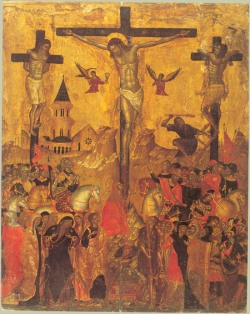 Icon of Christ's Crucifixion
The churches grew in size. As Tertullian put it to the Roman emperor at the beginning of the 3rd century, "The oftener you mow us down, the more of us there are. The blood of Christians is seed" (Apology 50). As the churches grew larger, more and more small towns had churches in them.
Some of these smaller churches did not have their own bishop, so the bishop of the nearest large town would serve the surrounding small towns. Even if the smaller churches had their own bishop, when they got together to consider major issues, the bishop of the large city would preside over the conference. Such a bishop was known in the third century as a "metropolitan."
And Finally Patriarchs
This progressed so far that by the Council of Nicea in A.D. 325, the metropolitans of Alexandria, Rome and Antioch were ruling over large areas. Canon VI of the Nicaean Council specifies the extent of Alexandria's rule, which included all of Egypt. Rome's rule is said to be something similar. (Thus eliminating the possibility that there was a pope in the first century.)
After Nicea, these three bishops were known as patriarchs. After Constantine built Constantinople and it became the capital of the Roman empire, its bishop also became a patriarch.
At the Council of Chalcedon in A.D. 451, there was a rift between the patriarch of Alexandria and the others over the dual natures (human and divine) of Christ. As a result, the patriarch of Alexandria and his churches have been out of communion with the others ever since. They are now known as the Coptic Church, and they later founded the Ethiopian Orthodox Church. Nonetheless, he appeared or sent a representative to all the later ecumenical councils (see below).
The metropolitan of Jerusalem was elevated to patriarch at the Council of Chalcedon in 451. That made five total.
Another major patriarch that needs to be mentioned is the one in Moscow that was added in 1589. The Russian Orthodox Church is the largest of the eastern Orthodox churches today.
The rule of the patriarchs is expressed through synods, or gatherings of bishops. Synods can be local or universal. The Orthodox Churches recognize 7 universal synods or "ecumenical councils" throughout history, which they believe to hold authority over all Christians.
The Seven Ecumenical Councils
- First Council of Nicea: A.D. 325
- First Council of Constantinople: A.D. 381
- Council of Ephesus: A.D. 431
- Council of Chalcedon: A.D. 451
- Second Council of Constantinople: A.D. 553
- Third Council of Constantinople: A.D. 680-681
- Second Council of Nicea: A.D. 787
The Great Schism
The Roman Patriarch as "Pope"
Cyprian, bishop of Carthage in north Africa from A.D. 249 to 258, is considered a saint by the Roman Catholic Church. He is often (mis)quoted by the RCC as supporting the papacy because he stated that the keys of the kingdom of heaven, given to Peter by Christ in Matthew 16:19, were passed on to the bishops of the Church. Rome cites his support for Peter, but fails to point out that he never ties Peter to the bishop of Rome. Only the Pope himself does.
Yet when Stephen, bishop and patriarch of Rome (A.D. 250, before there was a pope), decided that the Church should accept baptisms performed by the Novatian schismatics, Cyprian called a council specifically to override him. That council, composed of 87 bishops, determined, "None of us may set himself up as a bishop of bishops, nor … compel his fellow bishop to the necessity of obedience" (Ante-Nicene Fathers, vol. V, "The Seventh Council of Carthage under Cyprian").
The bishop of Rome was given the authority of a patriarch by the Council of Nicea in A.D. 325. He assigned himself papal authority only later, during the political separation of the eastern and western Roman empire. He did this without affirmation of any of the other patriarchs, and without any precedent in the apostolic churches.
The western half of the Roman empire fell in A.D. 476. The eastern half continued as the Holy Roman Empire for a thousand years.
The political separation brought a breach in communications between the patriarchs as well. Unfortunately, only the patriarch of Rome was in the west. The other four patriarchs were all in the East.
During that time of political separation between east and west, the Roman church added a short phrase to the Nicene Creed. The eastern version of the creed said that the Holy Spirit proceeded from the Father, while the western version said that he proceeds from the Father and the Son.
That phrase "and the Son" in Latin is all one word: filioque, and it has become famous as "the filioque."
The patriarchs in the east felt that it was inappropriate for the bishop of Rome to act alone in changing such a major creed of the Church, no matter how accurate that change might be. They explained to the bishop—who by now could appropriately be called the pope, as he was now ruling alone in the west—that he was not a lone ruler. He was the leading patriarch, but he was "first among equals." They were required to act together.
The debate raged for centuries before it came to a head. In 1054 Pope Leo IX send a delegation to patriarch Michael Cerularius of Constantinople to remove his title of patriarch and to demand his submission to Rome. Cerularius refused, and the two patriarchs excommunicated each other.
The breach has never been healed.
The Orthodox Churches
The patriarchs of the east still consider themselves the rightful leaders of the universal church along with the pope in Rome. In fact, they consider themselves to be prevented from holding any more authoritative general ecumenical councils because they do not have the Roman patriarch among them.
To the Orthodox churches there are seven ecumenical councils that are the authoritative councils of history. No others can be held until the rift is reconciled. (Note: The Coptic Orthodox Church and some other small Orthodox Churches only receive the first three ecumenical councils, even though Alexandria was represented at later ones. Having been condemned and excommunicated at the 4th ecumenical council, it is not surprising that Alexandria does not hold later councils as authoritative.)
The patriarch of Rome, as we all know, is under no such restraints. He has never backed off from espousing his own authority. An ecumenical council is not required for important changes to tradition in his opinion. The Roman church believes it is possible for the pope to speak ex cathedra, which means "from the chair" or "from the throne", and that such a pronouncement is infallible.
Papal Infallibility
This page is not about Roman Catholicism, but such a grand claim as that the pope is infallible (in specific circumstances) needs to be examined, as does this claim from the "Catechism of the Catholic Church" ...
"For the Roman Pontiff, by reason of his office as Vicar of Christ, and as pastor of the entire Church has full, supreme, and universal power over the whole Church, a power which he can always exercise unhindered" (par. 882, accessed Dec. 19, 2014).
I reject these claims openly and often, and my opposition is often mistaken for anger or malice toward Roman Catholics. The sidebar above and the history that begins this page are the beginning of the evidence against the Pope's claims. More thorough evidence is presented at Is the Roman Catholic Church the One True Church?" and in my video teaching on the papacy in the early church.
"The Church" as Understood by the Orthodox Churches
The Orthodox Churches understand themselves to be a unity of churches rather than a large hierarchy. I cannot say personally that I'm convinced they pull this off, but I admire their explanation of it.
Conciliarity presents itself as an element of communion and unity, as an expression of the ecclesiastic ethos, as a lattice of inter-personal relations, but not as a faceless organization and an institutional operation. In the Orthodox Tradition, a synod (without being a formation that "hovers" above the local Churches) is an instrument that organically links the local Churches, thus transcending the temptation of being a universal organization. (Stavros Yagazoglou. "Conciliarity as an element of community and unity." Retrieved May 20, 2013 from http://www.oodegr.com/english/dogma/conciliar_unity.htm. It appears the blog is no longer online.)
The highest authority in the Orthodox Churches is the synod rather than an individual. The chief bishops (the metropolitans and patriarchs) come together at a synod to "express the Church's Eucharistic Conscience" (ibid.). The synod, in other words, is there to express what they believe has been revealed to and through the church, not to be a "faceless organization" or "institutional operation."
The Orthodox Churches Today
The four eastern patriarchs are the heads of the Orthodox Churches today. Their respective Churches are as follows:
- Patriarch of Constantinople: Eastern Orthodox Church
- Patriarch of Antioch: Greek Orthodox Church of Antioch
- Patriarch of Moscow: Russian Orthodox Church
- Patriarch of Jerusalem: Greek Orthodox Church of Jerusalem
As I mentioned, the patriarch of Alexandria has been out of communion with the others since A.D. 451 over a dispute about the dual natures (human and divine) of Christ. He is the head of the Coptic Orthodox Church.
The Coptic Orthodox Church has also given Ethiopia a patriarch, in 1959, so that now there is a Ethiopian Orthodox church as well.
The Alexandrian bishop goes by the title of pope as does the bishop of Rome. That's something we Americans are not familiar with, but in Egypt, of course, "the pope" is the Alexandrian patriarch, not the Roman one. The Alexandrian bishop was actually called pope long before the Roman bishop had such a title. Bishop Heraclas of Alexandria was addressed as pope during his rule from A.D. 232 to 249.
Persian and St. Thomas Orthodox Churches
Only recently have I become familiar with the Persian Orthodox Church, which grew up outside the Roman empire in Persia to the east. Even further east is the St. Thomas Orthodox Church in India, which claims to have been started by the apostle Thomas. That claim is not generally disputed, but the St. Thomas Orthodox Church has a very difficult history since they were discovered by Portuguese Catholics in the sixteenth century. Their history is definitely not simple.
I cannot make the history of these Orthodox Churches a priority at this time. The Wikipedia article on the St. Thomas Orthodox Church is well referenced and worth reading. They have several congregations in the United States with web pages that can be found with an internet search.
I was unable to find any web pages on the Persian Orthodox Church. A friend of mine found a 500-page book on their history called A History of Christianity in Asia by Samuel Hugh Moffett. He lists it among the top ten books he has ever read.
Doctrines of the Orthodox Churches
 Icon of "Our Lady of Vladimir"
The Orthodox Churches—to a modern Protestant mind—bear a lot of resemblances to the Roman Catholic Church. They have liturgy, they call their leaders priests, they have sacraments that communicate grace, and they do not emphasize being experientially born again the way Evangelicals do.
There are differences. Obviously the greatest one is that they are not subject to the bishop of Rome, though if fellowship were restored, he would be the "first among equals."
I have told Roman Catholics that they do not believe the Nicene view of the Trinity. The Orthodox do. The best way I can think of to describe it is that they have a much more mystical view of Divinity. The Roman Catholics and their Protestant descendants, however, are strongly influenced by a very legal, logical, western mindset. As a result, they have defined the Trinity so carefully that their definition disagrees with the very creed that they hold authoritative.
I read a blog recently from an Orthodox man (which is no longer on the internet) that describes their approach to Christianity this way:
Roman Catholicism and Protestantism are both primarily based on a legalistic, rationalistic cosmology. To the Orthodox, this is heresy and flies in the face of what the true Christian Church has always taught: that Salvation and the Sacraments are Holy Mysteries.
This thought makes a significant difference in the way we read the Scriptures. As a historian, with expertise only on Nicene and pre-Nicene era, I find that the pre-Nicene Christians had a similar mindset. While they explored wildly for the "why" behind the things of God, they were much more willing to accept "mystery" as the answer than modern, western Christians are.
My Own Experience with the Orthodox
Although the practice of icons and the Orthodox exclusivity based on hierarchy are a problem to me, I have found them to be much better preservers of early apostolic teaching than the Roman Catholic Church.
You'll see in the "center box" below ("The Orthodox and the Pope") that the Orthodox have a strong emphasis on the local church and the priesthood of the believer. The authority of the hierarchy does not, or at least is not supposed to flow, from the top down, but from the bottom up. The clergy of the Orthodox churches are to represent the wholeness of the local church, whereas the Roman Catholics teach clearly the top-down authority of the "magisterium" and the pope (e.g., Catechism of the Catholic Church. Par. 2033 and 882)
Jesus forbad the top-down authority practiced by the world in passages like Mark 10:42-44:
Jesus called them to him and said to them, "You know that those who are considered to rule over the Gentiles exercise lordship over them, and their great ones exercise authority upon them, but it shall not be so among you. Whoever wants to be great among you shall be your servant, and whoever wants to be the greatest shall be the servant of everyone.
While I continue to reject some of the rituals, which I consider to be crystallization rather than progress, I am continually surprised by the preservation of apostolic and early church doctrines in uncrystallized forms by the Orthodox churches.
For example, whereas the westernized Roman Catholic Church has narrowly defined the presence of Jesus in their doctrine of transsubstantiation, the Orthodox, who honor the Eucharist every bit as much as the RCC, has a less defined, more palatable idea of Jesus' body and blood being in the Eucharist.
[The Eucharist] is always given in both forms—bread and wine. It is strictly understood as being the real presence of Christ, his true Body and Blood mystically present in the bread and wine which are offered to the Father in his name and consecrated by the divine Spirit of God. ("Holy Eucharist." 1996-2014. Orthodox Church in America. Accessed Dec. 21, 2014. Emphasis mine.)
As another example, I have been seeing both in the Scriptures and in the early Christian writings—and will be writing on it soon—that the Lord's Supper was originally a meal. It was so much a meal that the early Christians would bring some home to the sick who could not attend the meeting.
The Orthodox still maintain this practice. They even have a name for it: Antidoron, a Greek word meaning "instead of the gifts." In many (most?) Orthodox congregations, loaves are cooked both for a meal for those who attend the meeting, as well as one loaf which will be blessed and broken as the Eucharist. The leftover loaves are taken to those who cannot attend.
There are several traditions that can't be traced to the early Christians associated with the Antidoron. One interesting one that can is the care that is taught to adults and children alike not to drop even a crumb.* Tertullian, around AD 200, cites several traditions he believes are so ancient and agreed upon that Christians all agreed they were apostolic, and one was "We feel pained should any wine or bread, even though our own, be cast upon the ground. (De Corona 3)
*"The Proper Understanding and Use of Antidoron." Orthodox Christian Information Center. Undated. Accessed December 21, 2014.
Later I address icons on this page and another, but my respect for the Orthodox churches and their preservation of ancient tradition has grown as I have learned more about them.
I do wish that ancient churches like the Orthodox could extend their hand to those willing to learn from what they preserved, but not willing to submit to what they have clearly added, some of which at least borders on things God has expressly forbidden.
It saddens me that this seems to be impossible, though I, with the support of the church I am a part of, are going to at least extend our hand and see what happens. I'll let you know how that goes.
The Orthodox and the Pope
In the most basic sense, the Orthodox Church see the Pope as the "first among equals" among the patriarchs. For those that want a deeper understanding of the difference they see between the role of a patriarch and the role of a pope, let me quote an Orthodox web site. This is a difficult text to understand, but it is concise. I have included the part about the role of a bishop because it is essential to understanding the role of the leading bishops in a synod, which is the real governing authority in the eyes of the Orthodox Churches.
A Bishop is not rendered a source of power and administration in the ecclesiastic community because he as an individual has supposedly acquired juridical powers through his ordination. He, as the head of the Eucharist, assembles and represents the unity of the members of that specific Eucharist corpus; in other words, he represents the catholicity (the wholeness) of the local Church. At the same time, it is through its Bishop -only- that the local Church can transcend every localizing and introvert orientation and become united with other local Churches, in a communion of the One Church. Consequently, a synod comprised of Bishops is not a tertiary instrument of power or some kind of worldwide super-organization that draws its power from necessary polls; a synod is rather an expressing of the Church's Eucharistic conscience. (Stavros Yagazoglou, "Conciliarity as an element of communion and unity"; accessed May 20, 2013)
Here's my best short explanation of this paragraph. A bishop does not hold his power because of his position. His power comes from being a representative of the unity of the local church. Similarly, a synod of bishops is not just a gathered authority making decisions based on a vote. Instead, it represents the conscience of the whole Church.
Icons
The Orthodox Churches—at least the ones I'm (slightly) familiar with—put a lot of emphasis on icons, which are images of saints. They are careful not to make exact representations of the saints, and thus the images almost look like cartoons. (I don't mean any offense by that. If you have a better word, please tell me!) They call them "windows to heaven," and they keep them in their houses and their church buildings. They bow to them as they enter and leave.
The seventh ecumenical council, the Second Council of Nicea, concerned the subject of these icons. That council confirmed that icons could be used and "venerated." I should explain this briefly.
The Second Council of Nicea
The second Council of Nicea (A.D. 787) affirmed the "veneration" of icons. The word used in Greek is proskuneo, and they said it was different than divine worship which could only be given to God. The Greek word for that divine worship is latreuo. (From "The Decree of the Holy, Great, Ecumenical Synod, the Second of Nice.")
Jesus told the devil in Matthew 4:10, "Go away, Satan, because it is written, 'You shall worship [proskuneo] the Lord your God, and him only shall you serve [latreuo].'" The introduction to the Ethiopian Orthodox Bible argues that this verse says we must "only" latreuo God. However, there is no "only" in the first part of the sentence. Thus, the introduction argues that proskuneo should be given to God, but as long as it is understood as "bowing down" and not "worship," proskuneo can be offered to people, and icons, as well.
This argument, besides being foreign both to the apparent meaning of the text and to the interpretation of the Jews, whose text this was, has other problems as well. I address these at The Orthodox Church and Icons.
Further Information on the Orthodox Churches
The Orthodox Churches have a strong presence on the World Wide Web. There is even an Orthodox Wiki on the web.
As a word of advice, always use the references when you are on a wiki, whether it be Wikipedia or the Orthodox Wiki. Often they are clickable, allowing you to examine the sources for the article or to find the most reliable web sites for researching whatever topic you are examining.
I am interested in more information on the Orthodox Church. If there is a topic—and there are surely many—that ought to be added to this page, please use the "Contact Me" button on the NavBar to suggest it to me.

Recent Articles


-
The Role of Early Church Unity in Strengthening Modern-Day Faith
Dec 24, 25 01:51 PM
The Role of Early Church Unity in Strengthening Modern-Day Faith covers unity in early Christian history and modern application -
FAQ: How to Start Reading the Early Church Fathers
Jun 02, 25 04:01 PM
 People often ask me how to start reading the early church fathers. Here's the answer.
 -
Scripture Quotes About the Atonement
Jan 04, 25 12:22 PM
Scripture quotes about the atonement of Jesus Christ
Early Church History Newsletter
You will be notified of new articles, and I send teachings based on the pre-Nicene fathers intermittently.
When you sign up for my newsletter, your email address will not be shared. We will only use it to send you the newsletter.