Christian-History.org does not receive any personally identifiable information from the search bar below.
The Donation of Constantine:
The Great Forgery
The Donation of Constantine has not been held up as legitimate since corrupt Roman popes of medieval times. It was, however, a shock to Martin Luther to discover that the Donation of Constantine (and the Isidorian Decretals) were forgeries. It led him to debate whether the pope was antichrist himself.
Ad:
Our books consistently maintain 4-star and better ratings despite the occasional 1- and 2-star ratings from people angry because we have no respect for sacred cows.
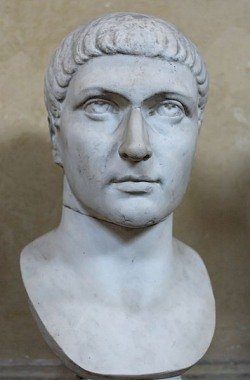 Bust of Constantine the Great
The Donation gives authority of the western Roman empire to the bishop of Rome, specifically to Sylvester. It mentions Rome, Italy, and "all the western regions." Then it adds that Constanine was returning to Constantinople to rule the east, since there is no point in a secular emperor ruling where God has planted the head of the Church.
Anyone with any knowledge of the emperor Constantine the Great would have to know the Donation could not be accurate. Constantine fought hard to unite the empire under his rule, only accomplishing that in 324, halfway through his reign. He called the Council of Nicea to ensure that his empire would not be split by the division of the Church. It is hardly likely that he would give away the western half of the Roman empire to a bishop that just two decades earlier was part of a growing but small and illegal religion.
The Donation of Constantine confers several other privileges on Sylvester that it's likely he would not have accepted had it been real—things such as the right to wear an imperial robe.
By the time of the Council of Nicea, in the middle of both Constantine's reign and Sylvester's tenure as bishop, Christians were still quite used to avoiding the pomp and circumstance of secular government. Tertullian had written a tract explaining why Christians don't wear crowns (De Corona) just a century earlier. Even as late as the Council of Nicea itself, Christians were forbidden military service (Canon 12).
The Donation goes on to say that Constantine led a horse with the pope on it. It says he was baptized in Rome by Sylvester and that he was cured of leprosy when it happened.
Basically, in every way, it claims that Constantine gave Sylvester, bishop of Rome, all the pomp and authority that popes had in medieval times.
Even the Roman Catholics admit it's a forgery. I even got a lot of the description of the Donation of Constantine itself from the Catholic Encyclopedia.
The Donation of Constantine: Passing off a Forgery
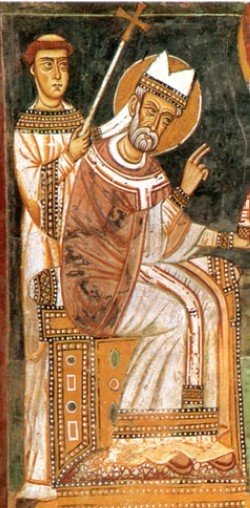 Pope Sylvester with Constantine the Great (supposedly)
Such a document would go nowhere today, but in medieval times, disparagingly but accurately called The Dark Ages (which is generally what a religious government will provide), it was easy to pass it off as true.
It's not really known when this document was created. Best guess is between 750 and 850. It was not exposed until 1440, when Lorenzo Valla's writings exposed it.
Though the Roman Catholic Church admits that the Donation of Constantine was a forgery, but it still claims that the pope "by reason of his office as Vicar of Christ, and as pastor of the entire Church has full, supreme, and universal power over the whole Church, a power which he can always exercise unhindered" Catechism of the Catholic Church. par. 882. Accessed Nov. 20, 2014). This claim is addressed in Is the Roman Catholic Church the One True Church?

Recent Articles


-
I Desire Mercy Not Sacrifice
Apr 22, 24 08:28 PM
Why did Hosea prophesy, 'I desire mercy and not sacrifice,' and why did Jesus quote it twice in the Gospel of Matthew? The answer may shock you. -
Reconciling the Evangelical Paul with the Biblical Paul
Mar 25, 24 12:53 PM
Paul does not need to be reconciled with James because he says all the things James does. We need to reconcile the evangelical Paul with the biblical Paul. -
How to Live Holy
Feb 28, 24 12:06 PM
The Bible clearly teaches us how to live holy by his grace, by the Holy Spirit, the fellowship of the church. It also calls us to make every effort.
Early Church History Newsletter
You will be notified of new articles, and I send teachings based on the pre-Nicene fathers intermittently.
When you sign up for my newsletter, your email address will not be shared. We will only use it to send you the newsletter.